This account is drawn from a TechFlow article published November 11, 2026, compiling Alea Research. It covers completed Q3 and October 2026 results and states later dates only as they were described then. Original article: https://www.techflowpost.com/zh-CN/article/35268
Q3 2026 network fees (completed)
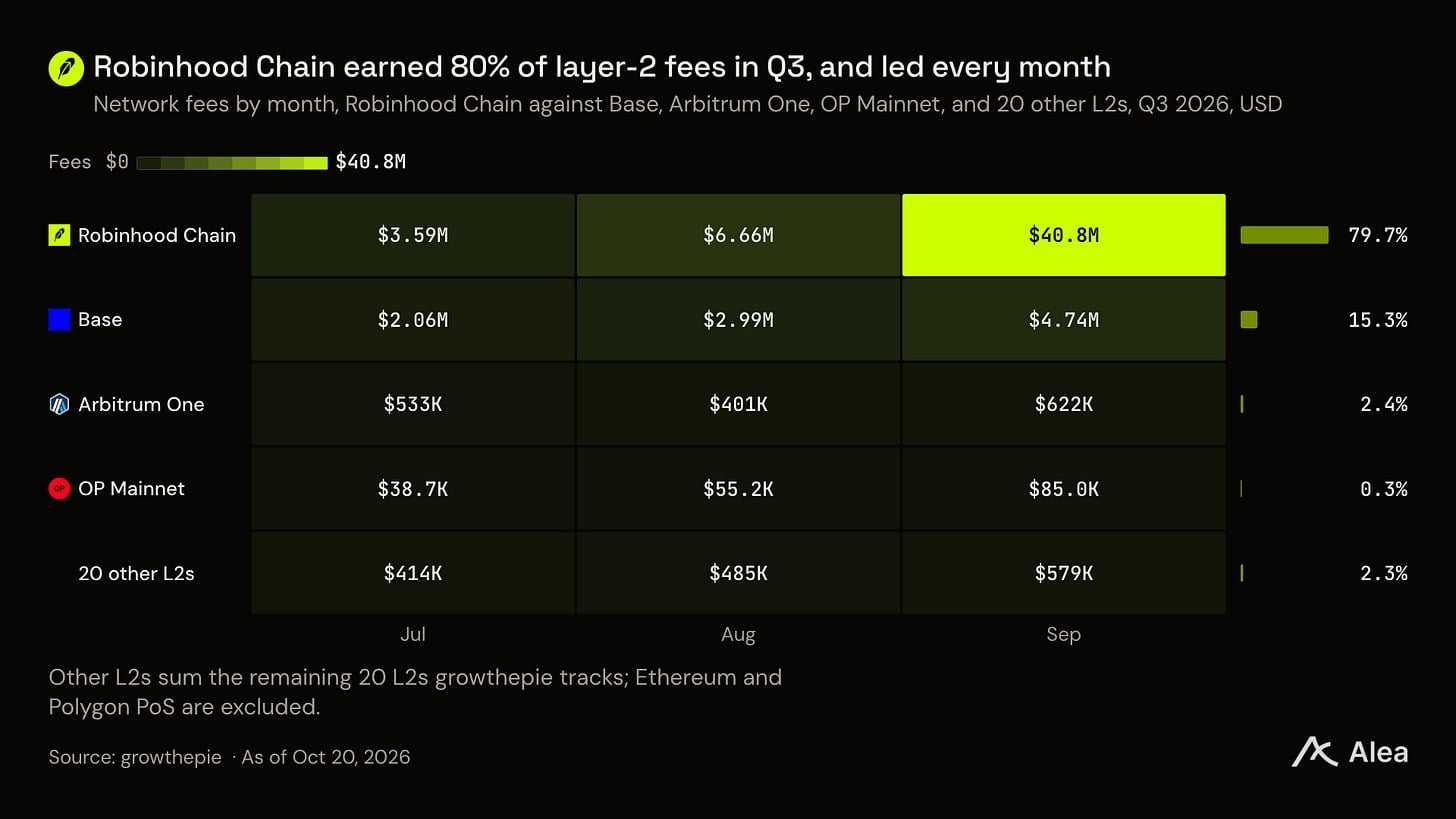
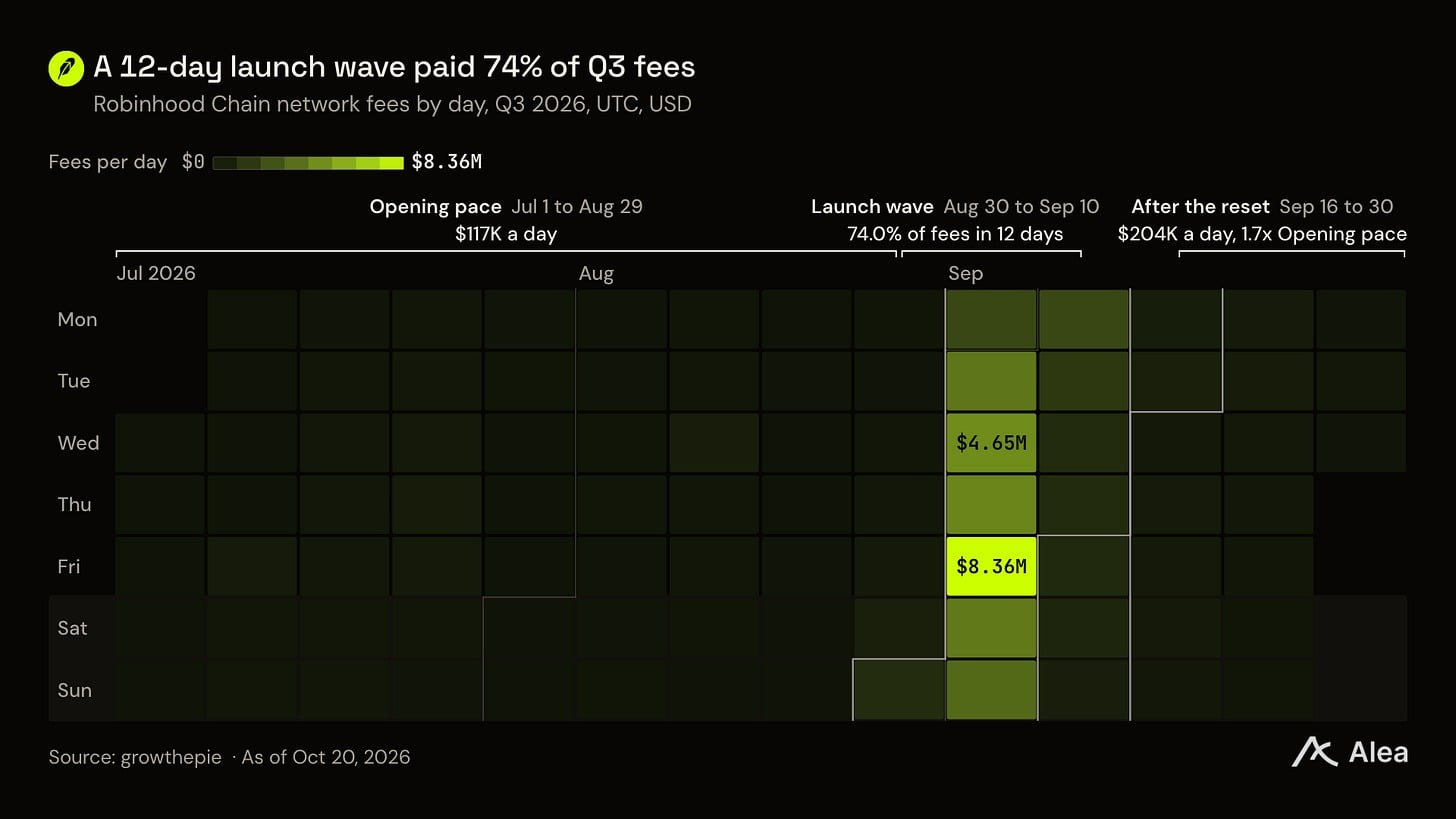
In the third quarter of 2026, the first full public quarter after mainnet launch, Robinhood Chain took about 80 percent of Ethereum Layer 2 network fee revenue. On-chain exchange volume was $90.7 billion, above the $50 billion of crypto volume matched together by the Robinhood application and Bitstamp. A token-launch wave supplied 74 percent of the chain’s fees. Stock tokens’ share of DEX volume rose through the quarter.
Monthly fee comparisons for Robinhood Chain, Base, Arbitrum One, and OP Mainnet were attributed to growthepie. Excluding that 12-day surge, the chain still accounted for 57.7 percent of all L2 network fees over the quarter’s other 80 days, versus 30.7 percent for Coinbase’s Base. In the last week of September, average daily fees had fallen back to the July 1–August 29 starting pace.
- Quarter network-fee revenue was $51 million. The median L2 figure was $24,700. Robinhood Chain led L2 network fees with or without the launch wave.
- From July to September, stock tokens moved from 2.6 percent to 15.6 percent of DEX volume. Before the Monday U.S. open, token prices pointed the correct way on all 37 weekend and holiday moves of 1 percent or more.
- At the start of operating day 92, the Steakhouse vault Robinhood Earn runs on Morpho held $499 million, 18 percent above Coinbase’s lending vault at the same stage.
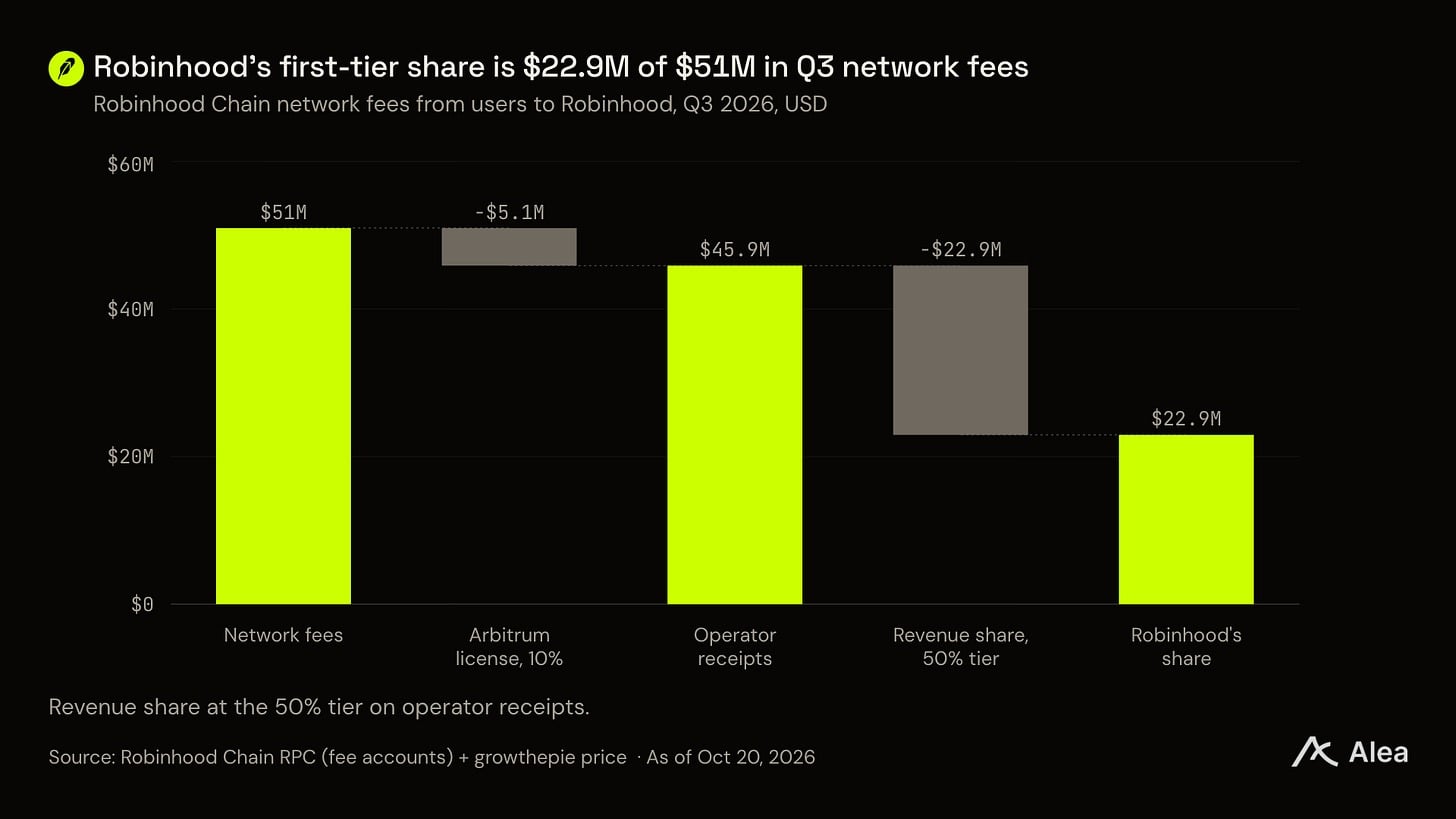
- At the first-tier split, Robinhood’s Q3 network-fee share was $22.9 million, equal to 19 percent of its $120 million total crypto revenue that quarter.
- After the wave, gas prices returned toward the low end of the range while returning addresses held up. September returning addresses exceeded Base. Application TVL on the chain reached $1.15 billion on October 22, then a record.
Fee split in force during the quarter
Robinhood Chain uses the Arbitrum stack and has no native token. Robinhood collects gas, as Coinbase does on Base, but shares a larger share with ecosystem parties. Arbitrum takes a 10 percent technology licensing fee on total network fees.
The rest is tiered. Until cumulative operating revenue reaches about $50 million, Robinhood retains 50 percent. The retained share is set to rise to 70 percent and then 85 percent as revenue grows. At the 50 percent tier, the Q3 amount was $22.9 million.
Traders also paid $593 million in application-layer fees in Q3; application operators kept $147 million. After a governance proposal passed, the Uniswap protocol fee switch was turned on for the chain on July 27. By September 30 it had funded buybacks and burns of UNI worth $13.7 million.
Launch wave: August 4 to mid-September (completed)
Average gas per transaction in Q3 was 6.4 cents, against 1.4 cents before the wave. Pons launched its V2 factory contract on August 4 and completed 648,701 token launches. Gas use rose above the preset target and the base fee climbed with the backlog.
August 30–September 10 produced 74 percent of quarterly network fees. On September 4, the busiest day, fees were $8.36 million, more than double all of July. Versus the prior 12 days, Pons V2 fee revenue rose 7.3 times while pump.fun fell 33 percent, so the spike was specific to this chain.
Robinhood raised the gas target twice within three days, to 40 million gas per second, then cut it to 15 million on October 18. Those capacity settings determined most of the quarter’s fee volume.
In the last week of September, average daily fees were $121,000: near the early dollar pace and 24 percent lower in ETH. From October 1 through October 19 the daily average was $54,600, under half the initial level, and launch-platform gas use fell 91 percent.
Stock tokens while the NYSE was closed
Stock tokens are Robinhood’s tokenized U.S. shares: debt claims collateralized one-for-one by the underlying stock and minted only by Bitstamp. In September, volume in pairs that were not new issues was $8.7 billion, above bStocks at $6.4 billion.
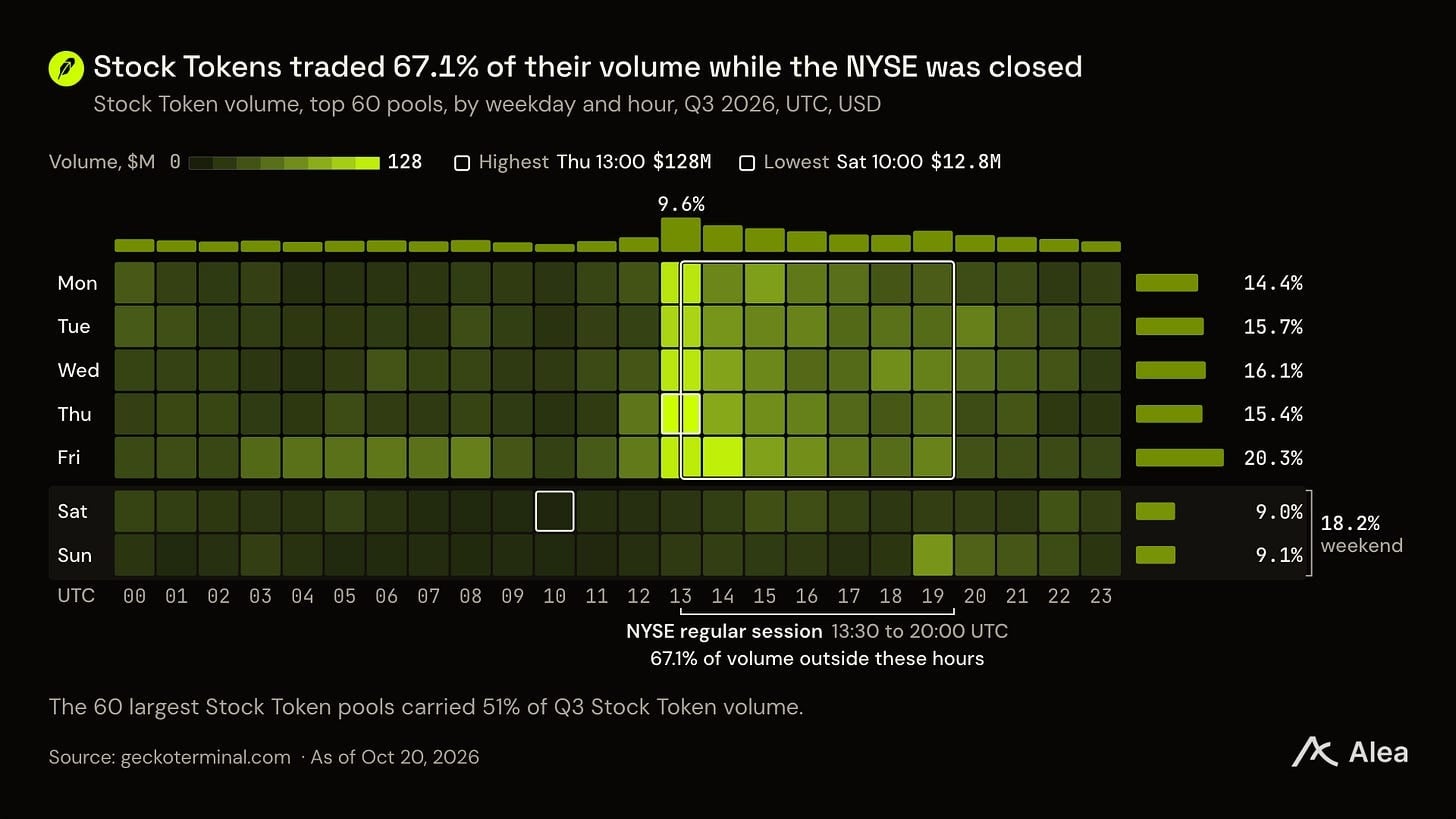
In the 60 largest stock-token pools, 67.1 percent of Q3 volume occurred while the NYSE was closed. Weekends alone were 18.2 percent, even though minting and redemption of the underlying shares were closed.
In the 30 minutes before the Monday open, all 37 weekend and holiday gaps of at least 1 percent were directionally indicated by the tokens, with a median capture of 86 percent of the move. At the September NYSE close, the median gap between the ten most active stock tokens and the underlying shares was 13 basis points, down from 29 basis points in July.
Robinhood has said it plans qualified-holder voting and redemption into the underlying shares. No date had been set. An SEC order dated September 17 allowed compliant U.S. venues to trade tokenized stocks that include dividends and voting rights, rights this product did not yet have.
October 2026 additions (completed by the November 11 report)
On October 22, Morpho and Robinhood opened lending that accepts stock tokens as collateral for stablecoin borrows. On October 27, Ondo added 15 tokenized stocks and ETFs; 11 trade in Uniswap pools directly against the matching Robinhood stock tokens. Ondo opens cross-chain mint and redeem for those 11 assets each day on Ethereum and BNB Chain, including weekends.
Robinhood’s October 27 earnings release ranked the chain among the top five public chains by revenue and trading volume.
Dates still ahead on November 11, 2026
These were checkpoints in the source, not events already executed:
- December 25, 2026 — projected from the October pace, not confirmed. At that pace the 70 percent retention tier would be reached. After October 26, cumulative operator revenue was $2.9 million short of the about $50 million threshold. Crossing it would raise Robinhood’s share of each new dollar of network fees. A change in pace would move the crossing.
- December 31, 2026 — scheduled expiry. The Robinhood Wallet gas subsidy ends. Until then the wallet pays gas in full on swaps above $0.50. January 2027 would be the first read of average daily fee demand without the subsidy.
- Early 2027 — conditional plan. If regulators approve, the Robinhood app is slated to offer weekend U.S. stock trading to domestic users who cannot yet hold stock tokens. No launch date was fixed.
The same report said that even after October gas revenue had fallen, $683 million of USDG was backed by Treasury reserves on the chain. At Treasury-bill rates that stock was put at about $26.9 million a year, described as three times Robinhood’s own gas share. Moving into the next fee tier would raise the share taken from each additional fee dollar.
None of these fee totals or calendar items is a statement about price. Figures, attributions, and the status of each date follow the November 11, 2026 TechFlow compilation of Alea Research.