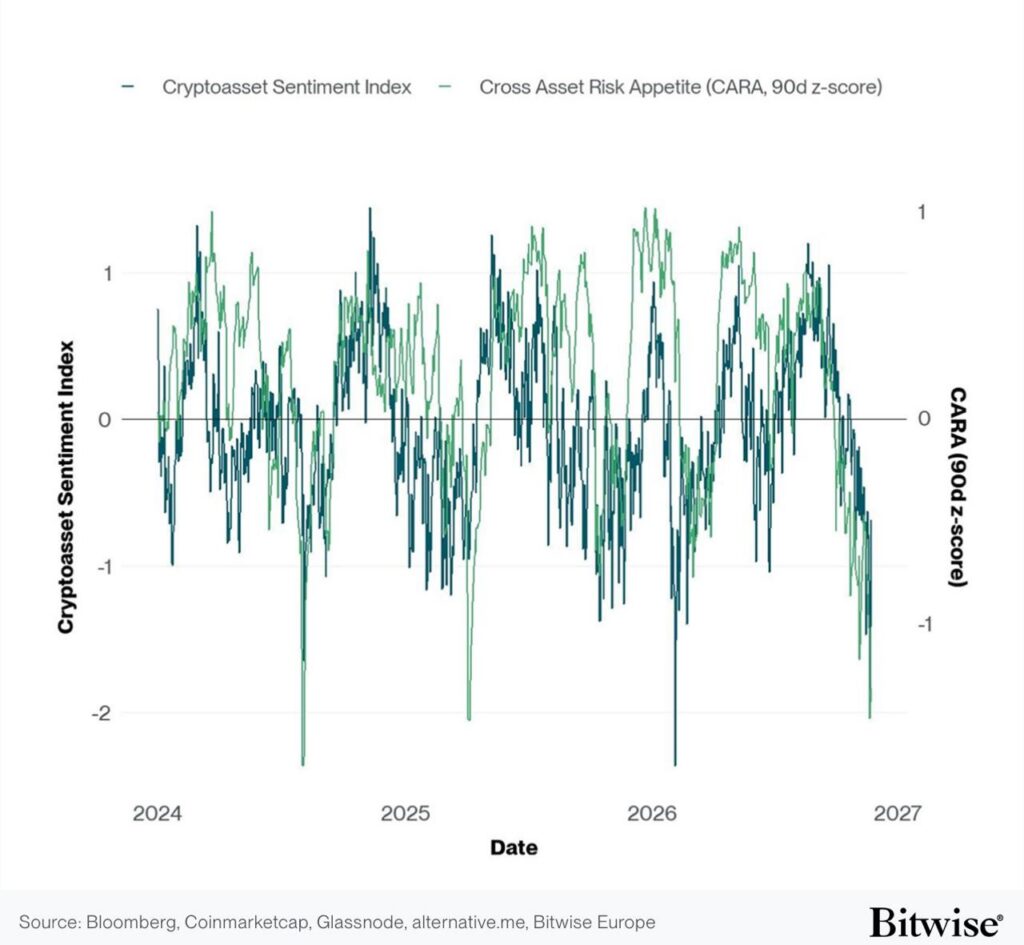
Bitwise’s Cryptoasset Sentiment Index fell to 1.88 standard deviations below its usual level on November 20, 2026. It was the weakest reading since February and, by the firm’s count, one of the three lowest since FTX collapsed in November 2022.
The timing matters: Bitwise published its week 48 Crypto Market Compass on November 23, but its sentiment and on-chain data ended on November 20. Neither measure captured Bitcoin’s November 21 drop to $55,130.
Through November 20: Bitcoin and stocks fell together
Bitcoin lost about 10% over the week, roughly matching the Nasdaq Composite. Ether fell 14%, the S&P 500 lost 8.6%, gold fell 8.9% and silver dropped 16%. Bitwise’s gauge of risk appetite across traditional markets fell from −0.51 to −1.11 after touching −1.14 midweek. The firm compared those levels with the mid-2024 yen carry-trade unwind and the early-2025 tariff selloff.
Only four of the crypto sentiment index’s 15 indicators remained above their short-term trends. Two futures indicators did improve, however: Bitcoin long futures leverage dominance and commercial traders’ net positioning on CME. Commercial traders cut their net short position from 11.11% to 7.28% of open interest. Bitwise interpreted the figures as evidence that leveraged longs had already been forced out.
Paper losses deepened, but weekly realized losses stayed below February’s
In the 14 days through November 20, the share of Bitcoin supply held at a profit fell from 59.1% to 43.2%. It had been lower on only 99 of the preceding 5,970 days. Bitwise estimated that about $953 billion of invested capital was held at a loss. The calculation uses the price at which each coin last moved; it measures coins, not individual investors.
Coins that moved on November 20 registered an estimated $1.36 billion in realized losses, a daily figure exceeded on only 18 earlier days. Yet the seven-day total of $5.3 billion remained below the roughly $5.7 billion recorded in November 2025 and $9.1 billion in February 2026. A transfer between wallets need not be a sale, so the figures do not establish how much holders actually sold.
Derivatives showed stronger demand for downside protection. Perpetual futures open interest fell about 4.5% to roughly 439,000 BTC, while options open interest rose about 18.5% to 548,100 BTC. On crypto-native exchanges, the put-to-call ratio reached 0.83, near the 99.9th percentile of its three-year range. The premium traders paid for puts over comparable calls, measured by 25-delta skew, was at or above the 99th percentile at every maturity from one week to six months.

November 21–23: Bitcoin set a cycle low and missed the Nasdaq rebound
Bitcoin’s November 21 low of $55,130 undercut the late-June trough near $58,000 and marked its lowest price since September 2024. It remained above the roughly $53,500 realized price, the average price at which all coins last moved on-chain. Bitcoin subsequently rebounded to about $61,000, still below the median last-moved price of about $64,300. Bitwise identified the long-term holder cost basis near $47,000 as a further reference point if the realized price failed, not as its base case.
On November 23, the Nasdaq gained 6.5%, but Bitcoin gave back its intraday rally. Fund flows in the preceding week showed redemptions at every major U.S. spot Bitcoin ETF in Bitwise’s data. Net outflows totaled $1.84 billion, including $1.37 billion from BlackRock’s IBIT, $119.3 million from Grayscale’s GBTC and $43.6 million from Bitwise’s BITB. U.S. spot Ether ETFs recorded $288.4 million in net outflows.

December: a rate increase was priced in, not decided
Bitwise attributed the broad selloff to expectations of tighter U.S. monetary policy. In the period it covered, federal funds futures implied a 93% probability of a December rate increase and a 63% probability of two more increases by January 2027. Federal Reserve Governor Christopher Waller had floated a 50-basis-point December move; the Fed had not decided on one.
Bitwise argued that the Fed was “approaching peak hawkishness.” With the 10-year Treasury yield at 4.95%, just 29 basis points above the two-year yield of 4.66%, the firm thought a large December hike would likely push the short-term yield above the long-term one. Its suggestion that a pause might follow drew on past cycles, not a Fed signal.
Bitwise also said similarly low crypto sentiment readings had historically preceded strong 12-month returns, but it provided neither a sample size nor a hit rate. The November 20 reading documented the depth of the decline in sentiment; it did not establish that Bitcoin had reached a bottom.