
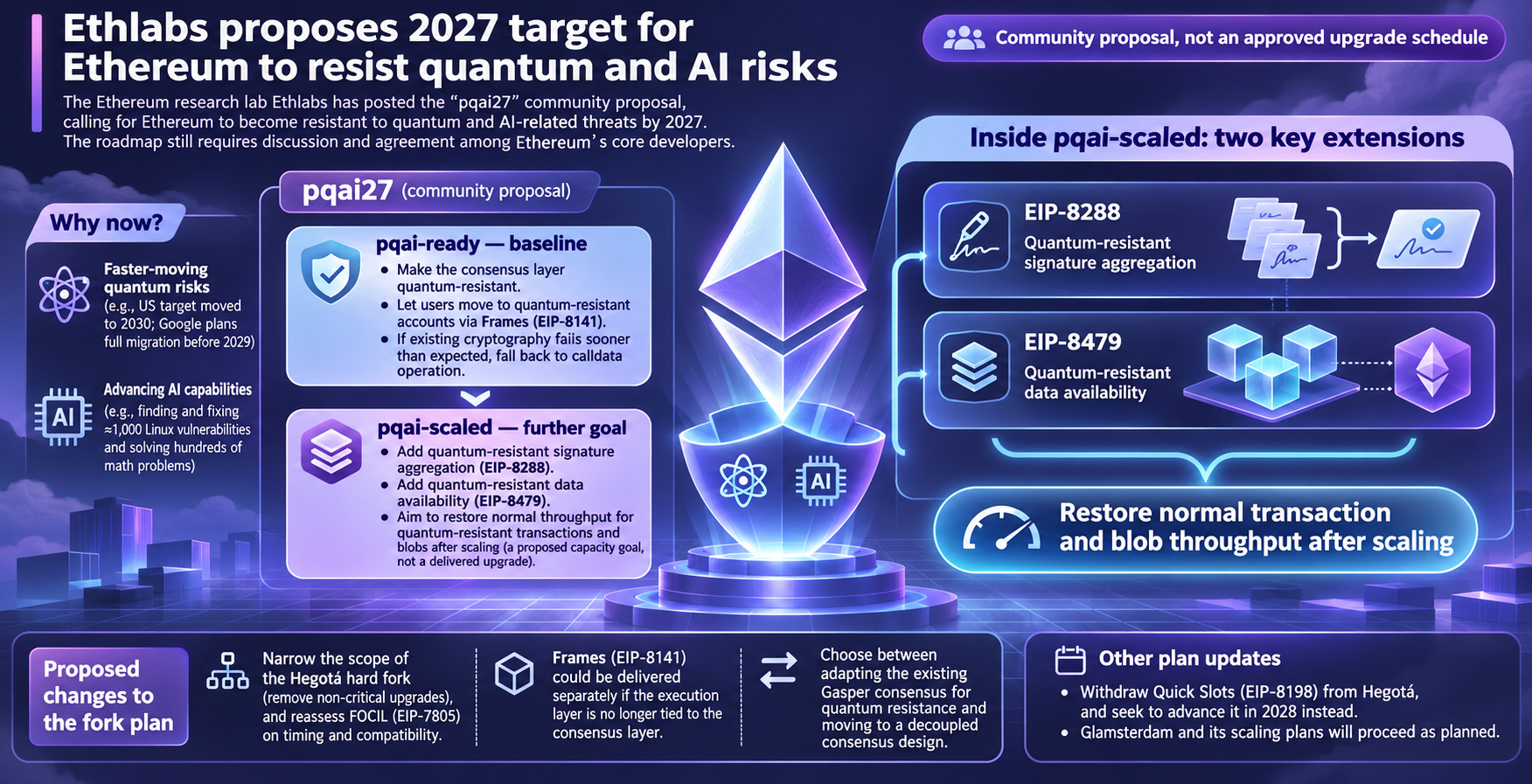
Status: Community proposal, not an approved Ethereum upgrade schedule. In an article published on November 12, 2026, at 11:42 a.m. UTC+8, TechFlow reported that nonprofit Ethereum research lab Ethlabs had posted its pqai27 proposal to a community forum. Ethlabs proposed making 2027 the target year for Ethereum to become resistant to quantum and AI-related threats. The roadmap still requires discussion and agreement among Ethereum’s core developers.
What the 2027 target would cover
Ethlabs divided the proposed roadmap into two goals:
- “pqai-ready” — a baseline: Make the consensus layer quantum-resistant and enable users to move to quantum-resistant accounts through Frames, the account-abstraction proposal EIP-8141. Ethlabs proposed that, if existing cryptography failed sooner than expected, the network could fall back to operating through calldata.
- “pqai-scaled” — a further goal: Add quantum-resistant signature aggregation under EIP-8288 and quantum-resistant data availability under EIP-8479. The aim would be to restore normal throughput for quantum-resistant transactions and blobs after scaling. This is a proposed capacity goal, not a delivered upgrade.
Proposed changes to the fork plan
Ethlabs recommended narrowing the scope of the Hegotá hard fork by removing upgrades outside the critical path and reassessing how the anti-censorship proposal FOCIL (EIP-7805) might affect timing and compatibility. It suggested Frames could be delivered separately if the execution layer were no longer tied to the consensus-layer schedule. Developers would also need to choose between adapting the existing Gasper consensus design for quantum resistance and moving to a decoupled consensus design.
Ethlabs said it was withdrawing its Quick Slots proposal (EIP-8198) from Hegotá and would seek to advance it in 2028 instead. The article said Glamsterdam and its scaling plans would proceed as planned. Neither statement establishes a completed fork or a guaranteed future date.
Ethlabs cited faster-moving quantum and AI risks as its rationale. The article said the US government had brought its quantum-resistance target forward from 2035 to 2030 and, citing Google’s cryptography migration timetable, said Google planned a full migration before 2029. It also reported that OpenAI had used frontier models to find and fix approximately 1,000 Linux vulnerabilities and solve hundreds of mathematics problems. For Ethlabs, “AI resistance” meant emphasizing simple hash-based primitives, formal verification and client diversity; it also argued AI could accelerate formal verification and zero-knowledge proof benchmark optimization.
As context, the article cited DeFiLlama data showing more than $41.16 billion in Ethereum total value locked as of November 12, 2026. That figure is not an upgrade milestone. Decisions on the proposed Hegotá changes and any consensus-layer switch remained pending core-developer discussion at the time of reporting.
Source: techflowpost.com (originally published 2026-11-12 11:42 UTC+8)