
Status as reported on November 11, 2026: Zodl had introduced an OHTTP-based wallet server architecture with version 3.20.0 and was rolling it out to users in batches over the following days. The report did not establish that every user had received the update.
A shielded Zcash transaction can conceal on-chain information, but a light wallet still contacts a server to retrieve data or broadcast a transaction. Without network-layer protection, that server can see the user’s IP address, request and connection time. Zodl’s change addresses that separate source of metadata exposure.
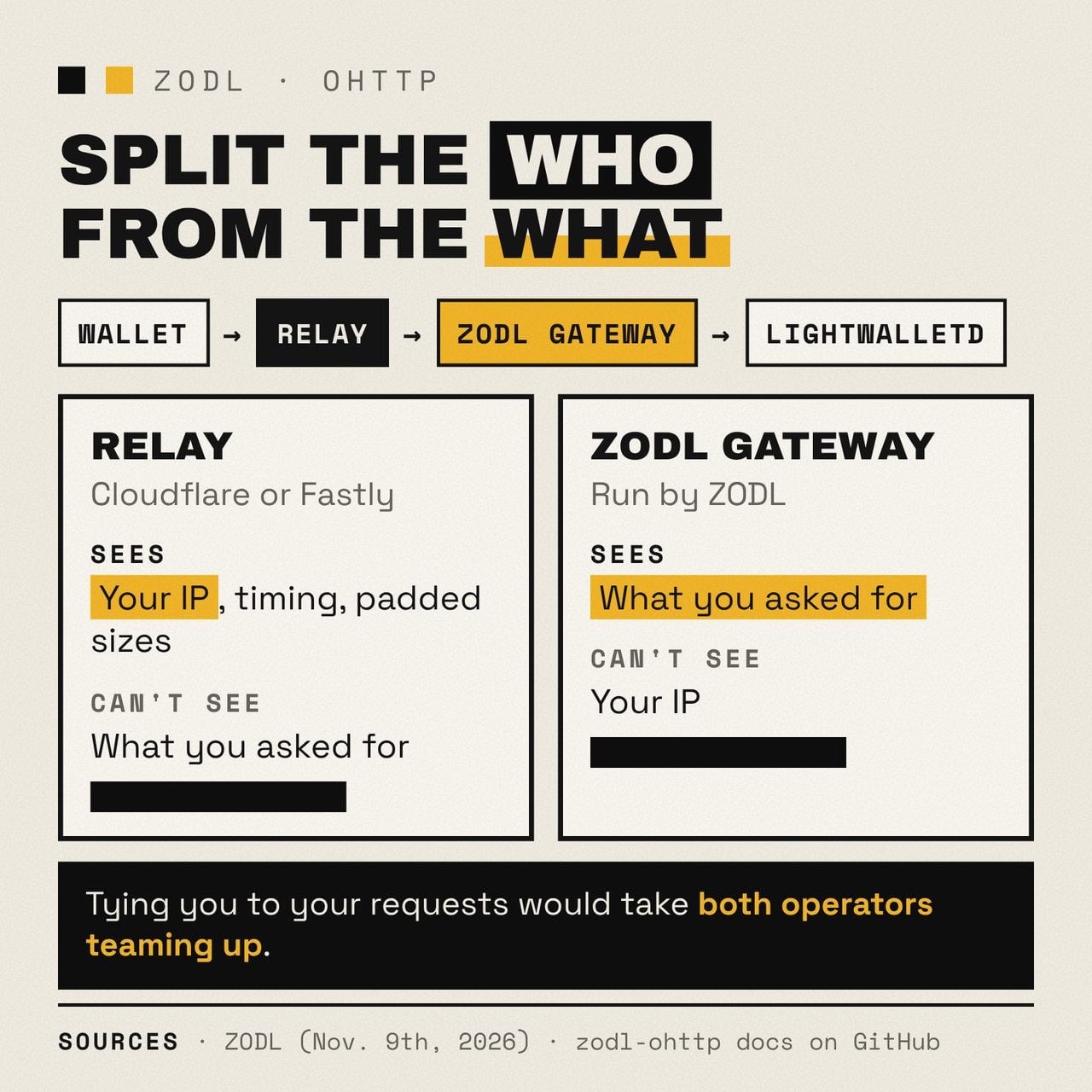
What changes in Zodl 3.20.0
The new default uses Oblivious HTTP (OHTTP) to split a request between a relay operated by Cloudflare or Fastly and a Zodl gateway. The wallet encrypts its request for the gateway before sending it through the relay. The relay can see the connecting IP address but not the request contents; the gateway can decrypt the request and forward it to lightwalletd, but sees the relay’s address rather than the user’s.
The reported implementation also pads requests into size bands of roughly 4 KB, with transaction broadcasts padded to at least 16 KB. Instead of writing relay request IDs in plain text to gateway logs, it records HMAC-derived values using a key held in gateway memory and destroyed on restart.
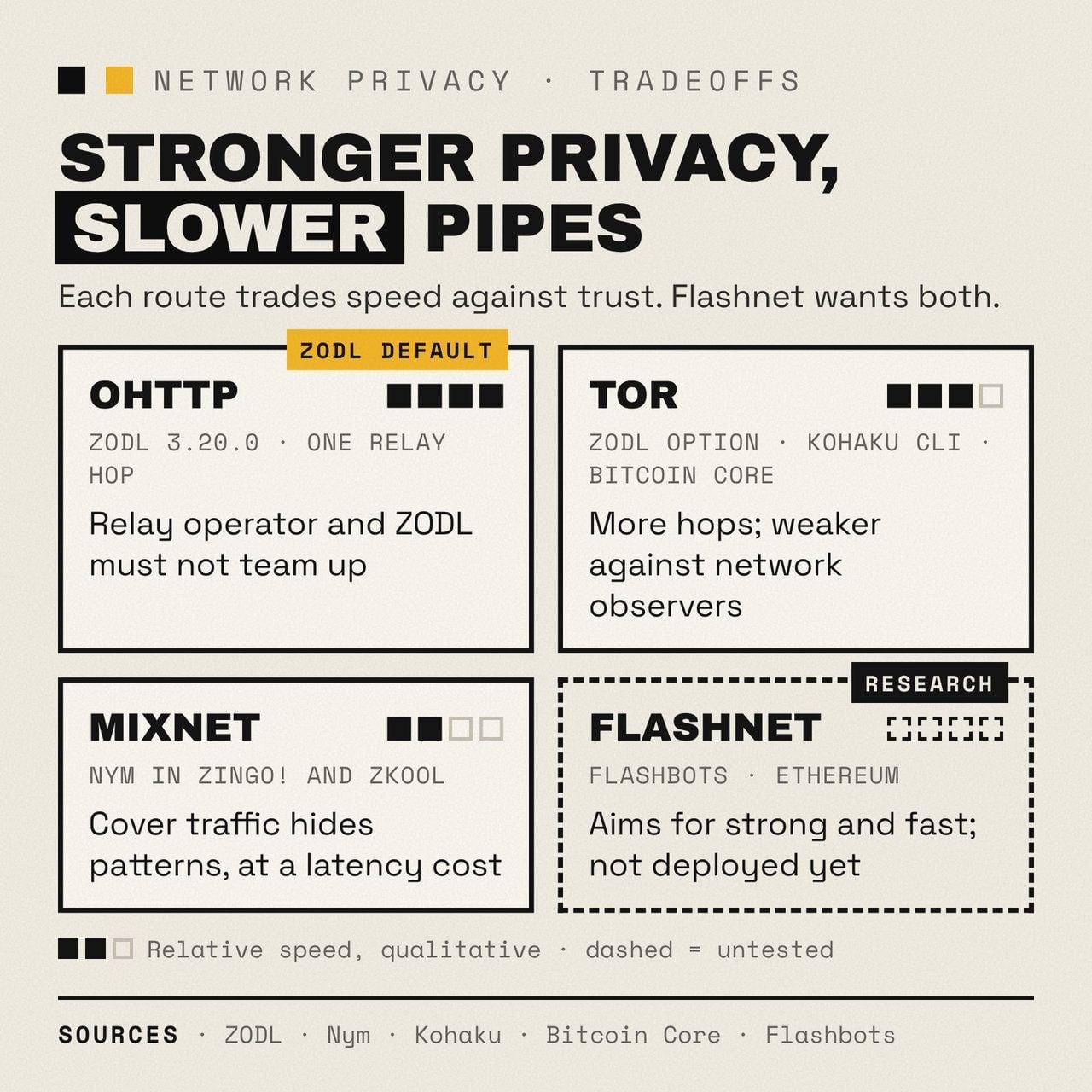
The trust limit matters: the separation depends on the relay operator and Zodl not cooperating. A relay can still observe connection timing and approximate traffic volume. Zodl contributor y4ss described OHTTP as a better default, not a substitute for Tor or Nym against a state-level adversary. Users concerned about pressure on cloud providers can also enable Zodl’s Tor option so the relay sees a Tor exit IP rather than their own.
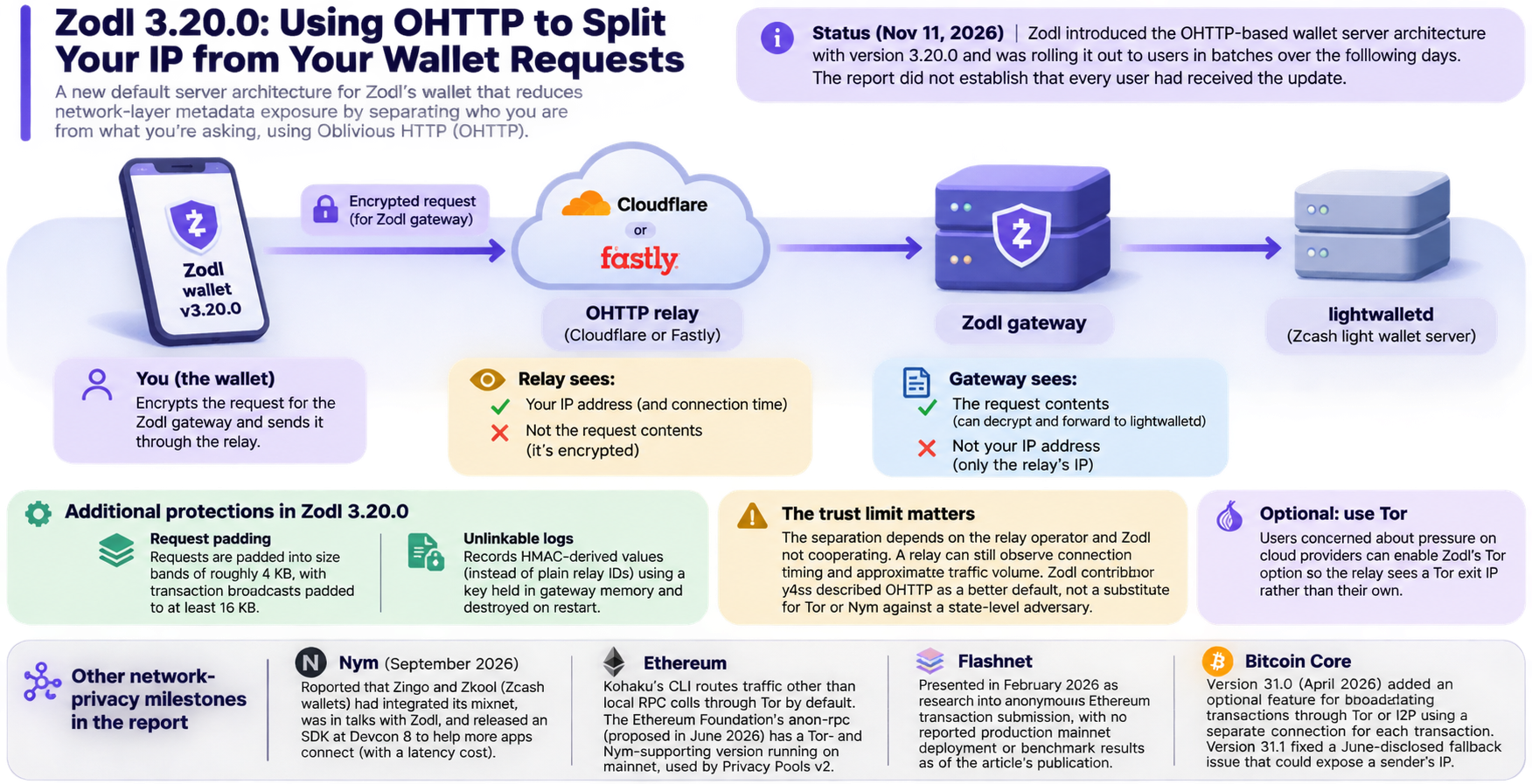
Other network-privacy milestones in the report
- September 2026: Nym reported that Zcash wallets Zingo and Zkool had integrated its mixnet. It said it was also in talks with Zodl. At Devcon 8, during the week before the November 11 report, Nym released an SDK intended to help more wallets and apps connect; mixnet routing carries a latency cost.
- Ethereum: The report said Kohaku’s command-line tool routed traffic other than local RPC calls through Tor by default. It described the Ethereum Foundation’s anon-rpc as a proposal made in June 2026 for a common wallet interface to anonymity networks, while reporting that a Tor- and Nym-supporting version was already running on mainnet and used by the Privacy Pools v2 web interface.
- Flashnet: Presented in February 2026 as research into anonymous Ethereum transaction submission, it had no reported production mainnet deployment or benchmark results as of the article’s publication.
- Bitcoin Core: The report said version 31.0, released in April 2026, added an optional feature for broadcasting transactions through Tor or I2P using a separate connection for each transaction. It also reported that version 31.1 fixed a June-disclosed fallback issue that could expose a sender’s IP if an anonymous-network handshake failed.
These are different approaches with different deployment states. Zodl’s dated milestone is a default-setting change and rollout, not a claim that network metadata can no longer be exposed.