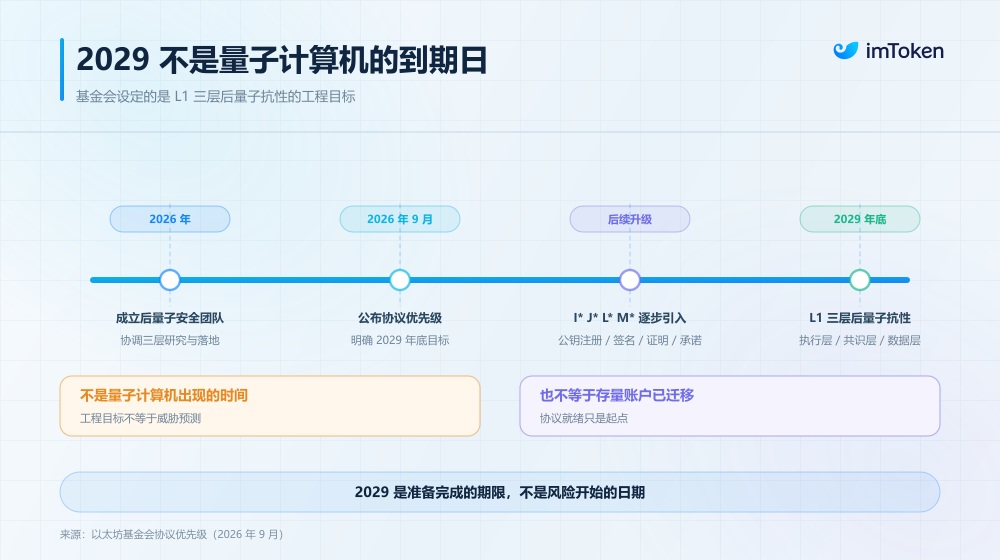
As reported on November 19, 2026, Ethereum’s post-quantum work had moved from a theoretical concern into protocol planning. The article says the Ethereum Foundation established a Post-Quantum Security team in 2026 and, in protocol priorities published that September, set a target of December 2029 for Ethereum L1 to achieve post-quantum resistance across its execution, consensus and data layers. That is an engineering goal, not an upgrade already completed or a guarantee that every part of the ecosystem will be ready by then.
What would need to change
Ethereum uses different cryptographic tools for different jobs. Ordinary externally owned accounts use ECDSA signatures; proof-of-stake validators use BLS signatures. A sufficiently capable fault-tolerant quantum computer running Shor’s algorithm could, in theory, undermine the mathematical assumptions behind both. The article says no quantum computer capable of breaking this cryptography existed at the time of reporting.
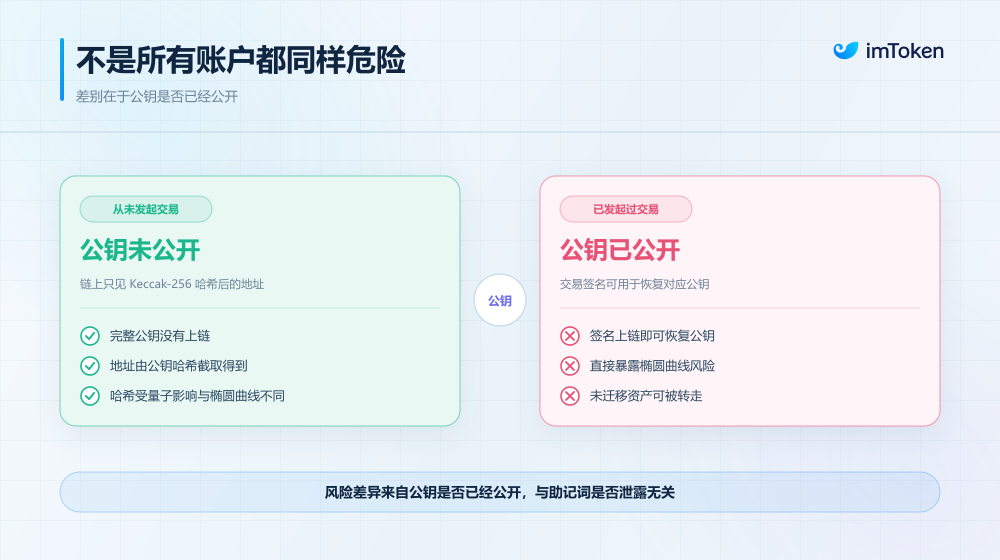
An account’s exposure also depends on its history. An Ethereum address is derived from a hash of its public key. If an account has never sent a transaction or otherwise disclosed a signature, its full public key may not be public. A transaction signature, however, can reveal the public key. This distinction does not make an unused account permanently quantum-safe; it describes its exposure under the threat considered in the article.
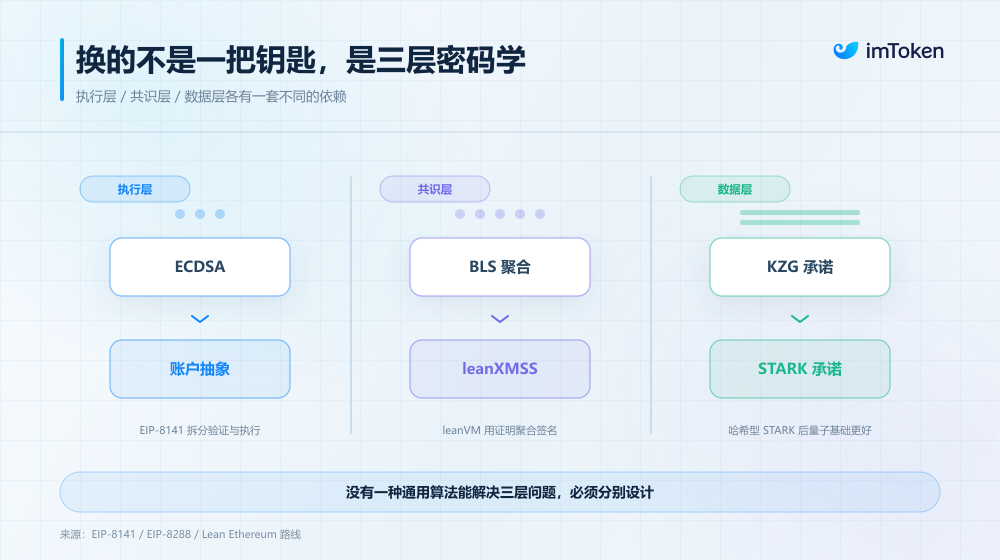
The roadmap described in the report spans three areas:
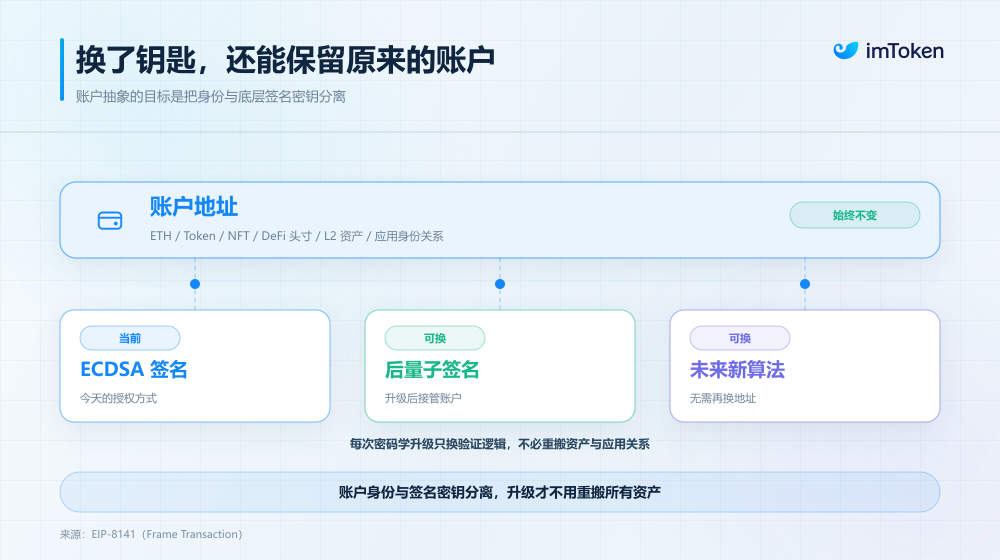
- Execution and accounts: EIP-8141 is presented as a proposal for more programmable account validation, potentially allowing key rotation without tying an account permanently to ECDSA. Post-quantum signature-verification precompiles are also under study. EIP-8288 proposes using recursive STARK aggregation to reduce the burden of verifying larger post-quantum signatures. These are proposed mechanisms, not capabilities the article says were already available to all accounts.
- Consensus: The Lean Ethereum approach described in the article explores leanXMSS, a hash-based signature scheme, as a possible replacement for validator BLS signatures. It also explores leanVM to aggregate proofs of those signatures, addressing the network and verification costs of larger signatures.
- Data and proofs: KZG commitments used with blobs and rollup data availability depend on cryptographic assumptions that also warrant review. Some pairing-based SNARKs face a related concern, while hash-based STARKs do not rely on the elliptic-curve discrete-logarithm assumption. The article notes that work beyond L1 would also be needed for rollups and applications.

The unresolved migration question
Changing a signature scheme is not the same as safely moving control of an existing account. The article describes an ideal transition in which a user authorizes a new post-quantum key while the old signature system remains secure. Once an attacker could forge signatures from an exposed public key, an old-key signature alone might no longer establish who owns the account.
Dormant accounts and lost keys pose a separate problem: their owners may be unable to authorize a migration. Whether such assets should remain at their existing addresses or face a future governance measure such as freezing was, at the time of reporting, unresolved. The article also warns that fraudulent “quantum-safe upgrade” or migration pages could exploit concern about the transition. Its near-term conclusion was preparation rather than a call for users to move assets urgently.