Status: Completed analysis, not a new protocol event. PANews published this review on November 11, 2026, at 18:43 China Standard Time (UTC+8). It was written by Sparsity and compiled by Saoirse for Foresight News. Figures below are the analysis’s reported measurements and comparisons, not a fresh count by this desk and not a statement that any price move followed.
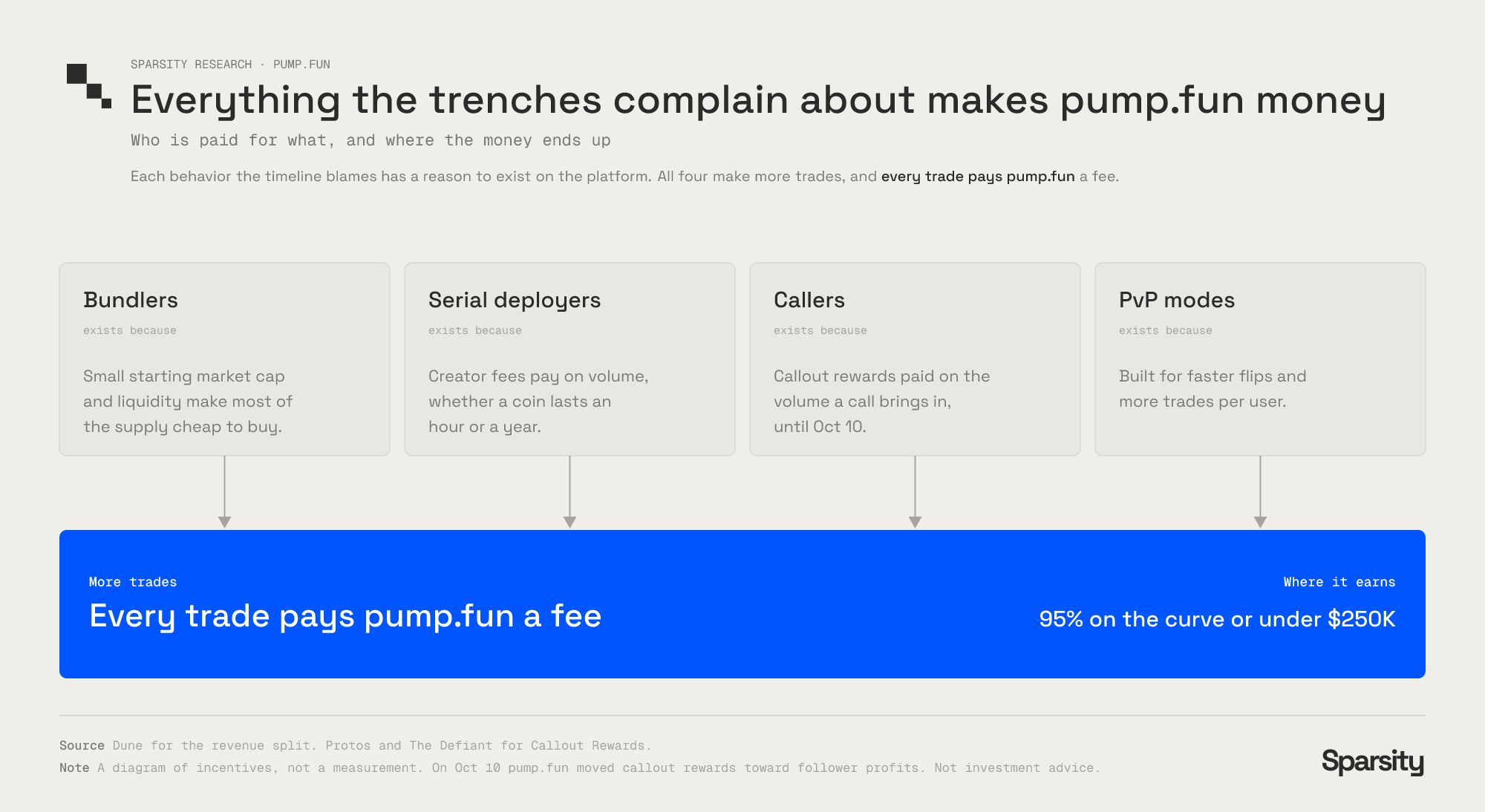
The essay’s claim is mechanical: as the largest meme-coin launch venue, Pump.fun’s fees and rewards paid for more launches and more trades, including in tokens that did not survive. It treats bundled launches, batch issuance, paid calls, and player-versus-player modes as fee-generating behavior, not as isolated bad actors at the end of the trade.
Share of issuance, as stated for the prior 30 days
In the 30 days before the write-up, the analysis says Pump.fun accounted for 92% of meme-coin launches across on-chain meme launch platforms and 84% of trading volume in that launch segment. It argues that this share is what made the platform’s rules decisive for which behavior paid.
Where protocol revenue sat (September 2, 2025–November 5, 2026)
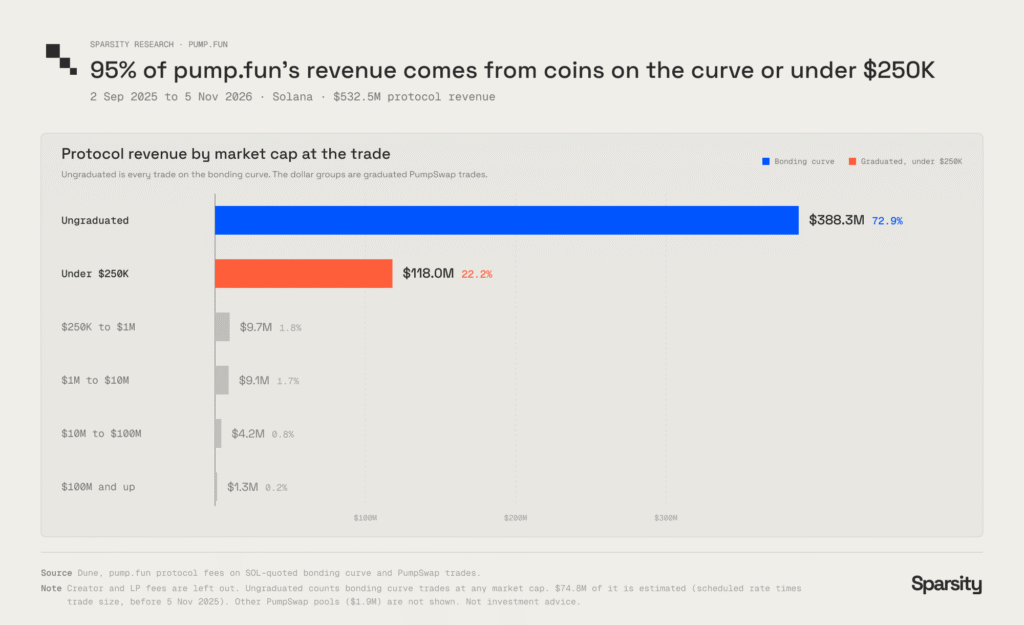
For September 2, 2025 through November 5, 2026, the analysis says 95% of Pump.fun protocol revenue came from tokens still on the bonding curve or with a market cap below $250,000.
On the bonding curve, each buy and each sell was charged 1.25%: 0.95% to Pump.fun and 0.30% to the token creator. A round trip was therefore 2.5% before any price change.
Revenue was described as concentrated while market caps were still in the hundreds of thousands of dollars. Whether a token later trended was said to matter little to platform revenue.
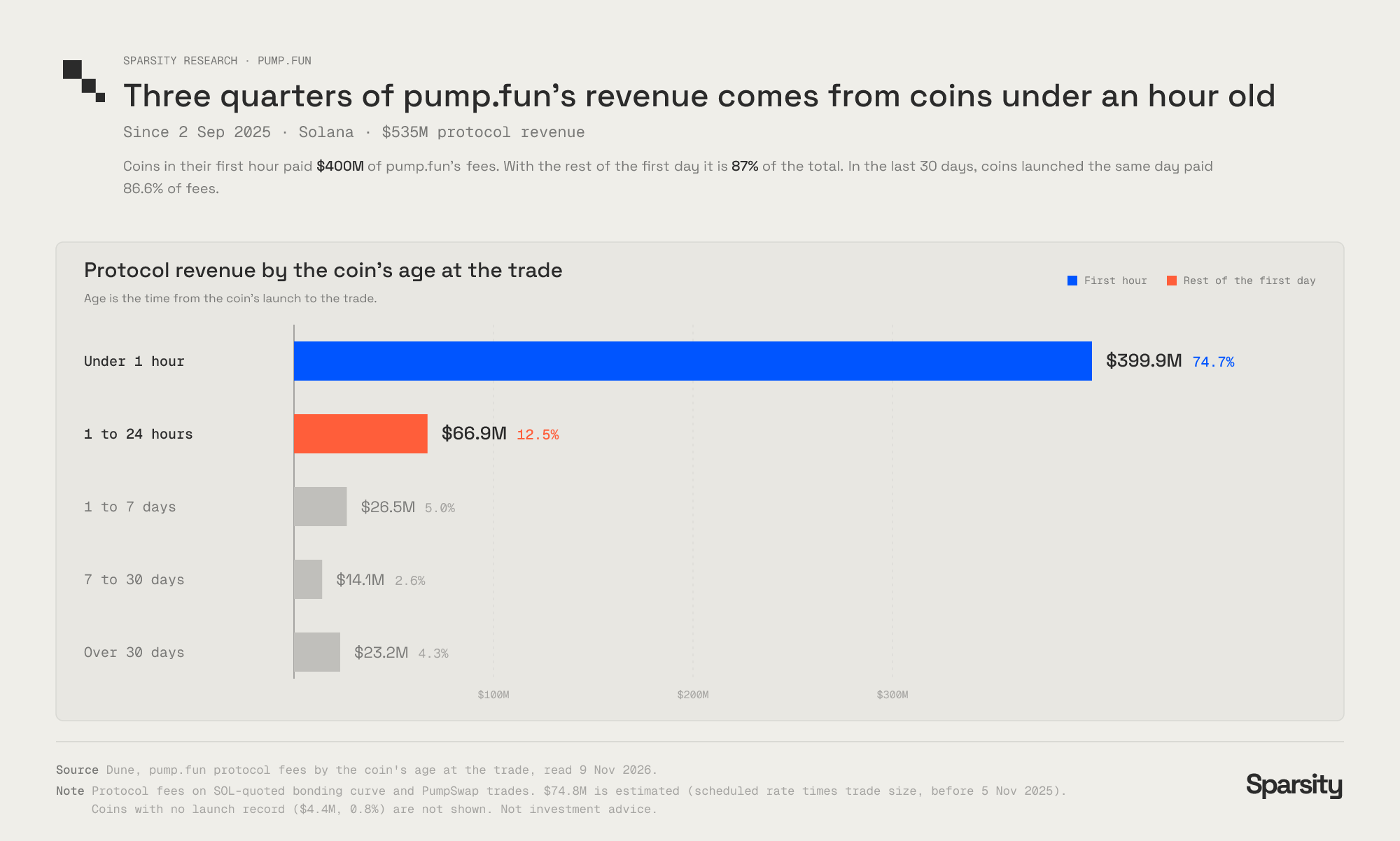
By token age, the same review says about three-quarters of revenue came from tokens online for less than one hour, and 87% from tokens online for less than one day. A caption dated from September 2, 2025 puts the under-one-hour share at nearly 75%, with first-day tokens again at 87%.
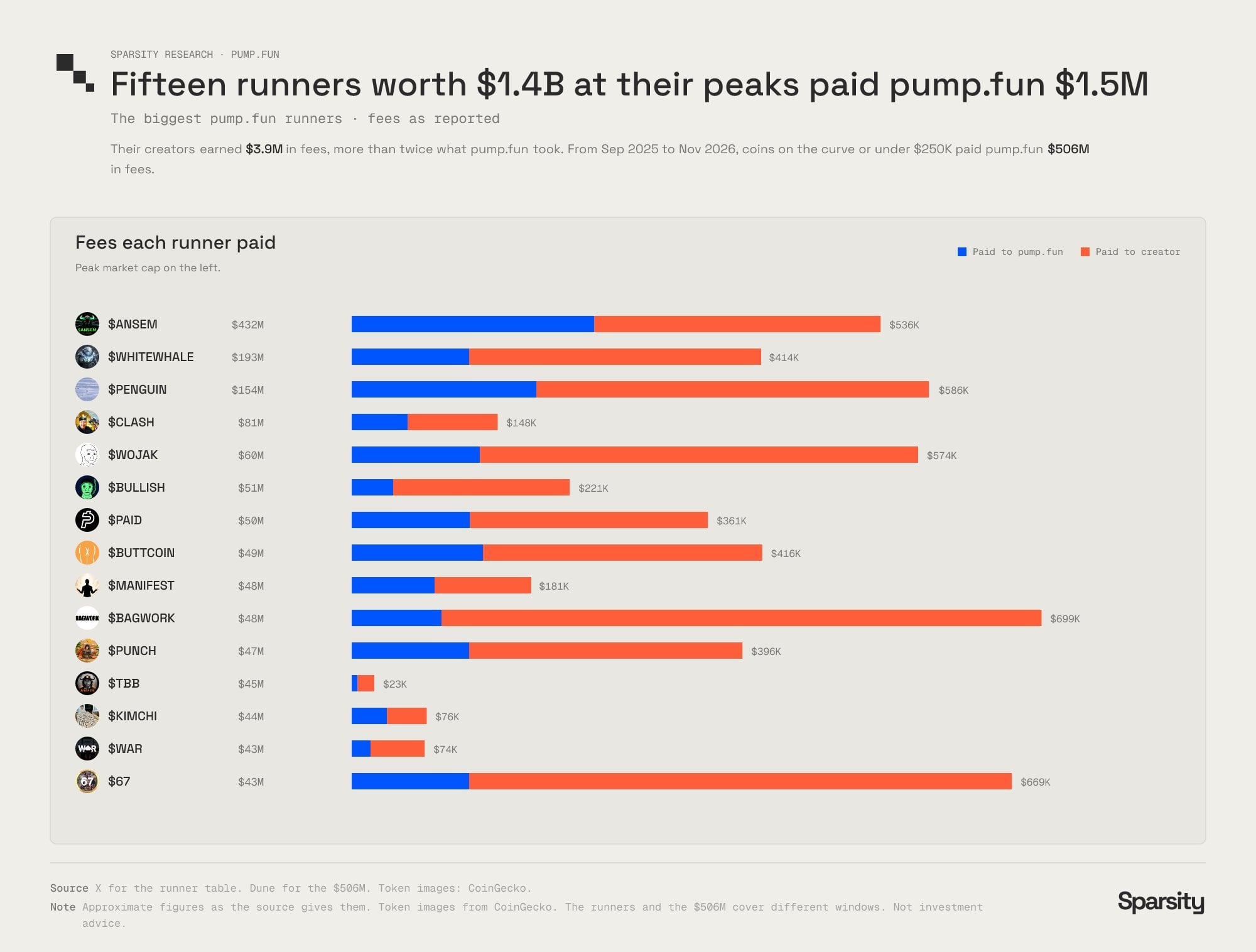
Fifteen tokens whose peak market caps totaled $1.4 billion were said to have produced only about $1.5 million in fees for Pump.fun. Tokens on the bonding curve or under a $250,000 market cap were said to have contributed $506 million. The analysis states that those 15 tokens’ fees were under 0.33% of the small-cap contribution, and it compares the platform take from 1,000 small tokens going to zero around a $20,000 market cap with the take from one token reaching a $100 million market cap, in favor of the small tokens.
Its design conclusion: the product was pointed at accepting more new listings. Incentives steered the market toward launch count, because trading volume was the base of platform revenue.
Four behaviors tied to the same fee
The review maps four criticized practices to the same cut. Bundled launches, batch issuance, paid calls, and player-versus-player trading all raise trade count, and Pump.fun was described as taking a fee on each trade.
Bundled launches. The stated cause is a low initial market cap and low initial liquidity, parameters the analysis attributes to Pump.fun. A trader could spread a small amount of SOL across dozens of wallets, take a large share of supply in the launch block, and sell to later traders. A lower starting market cap made that cheaper.
Batch issuance. Creator rewards were tied to issuance and volume, not to operating a token over time. The creator fee remained 0.30% of each trade whether the token lasted an hour or longer, so the described rational path was to launch often, take early volume, and move on.
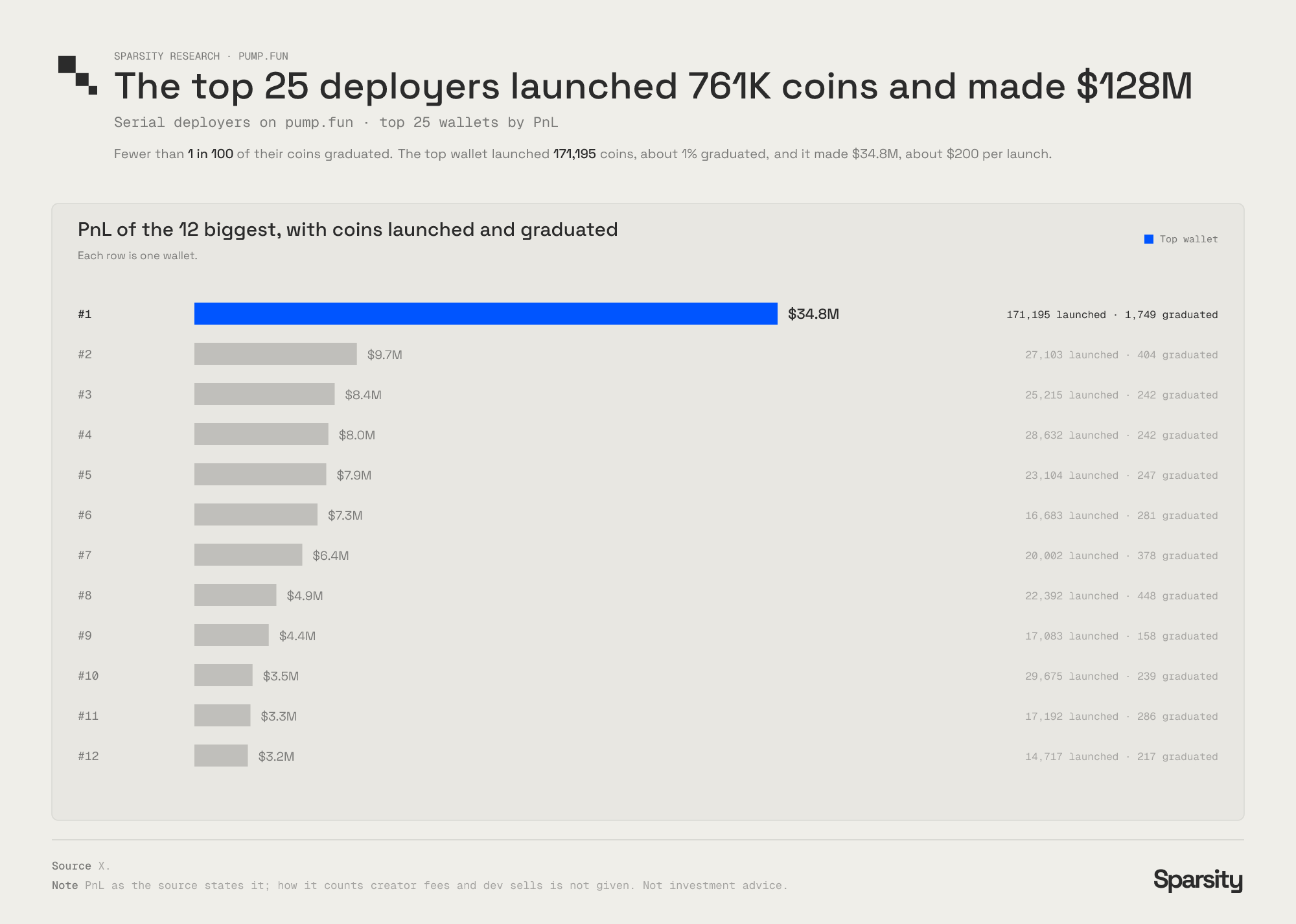
The top 25 launch addresses were said to have issued 761,000 tokens combined, with a “graduation” rate under 1%, and to have made $128 million. The leading wallet alone issued 171,195 tokens, at about $200 of revenue per token on average. Two wallets in that activity were also credited with tokens that later peaked at $122 million and $327 million in market cap. The analysis treats those hits as incidental; the core source of issuer revenue was early trading flow.
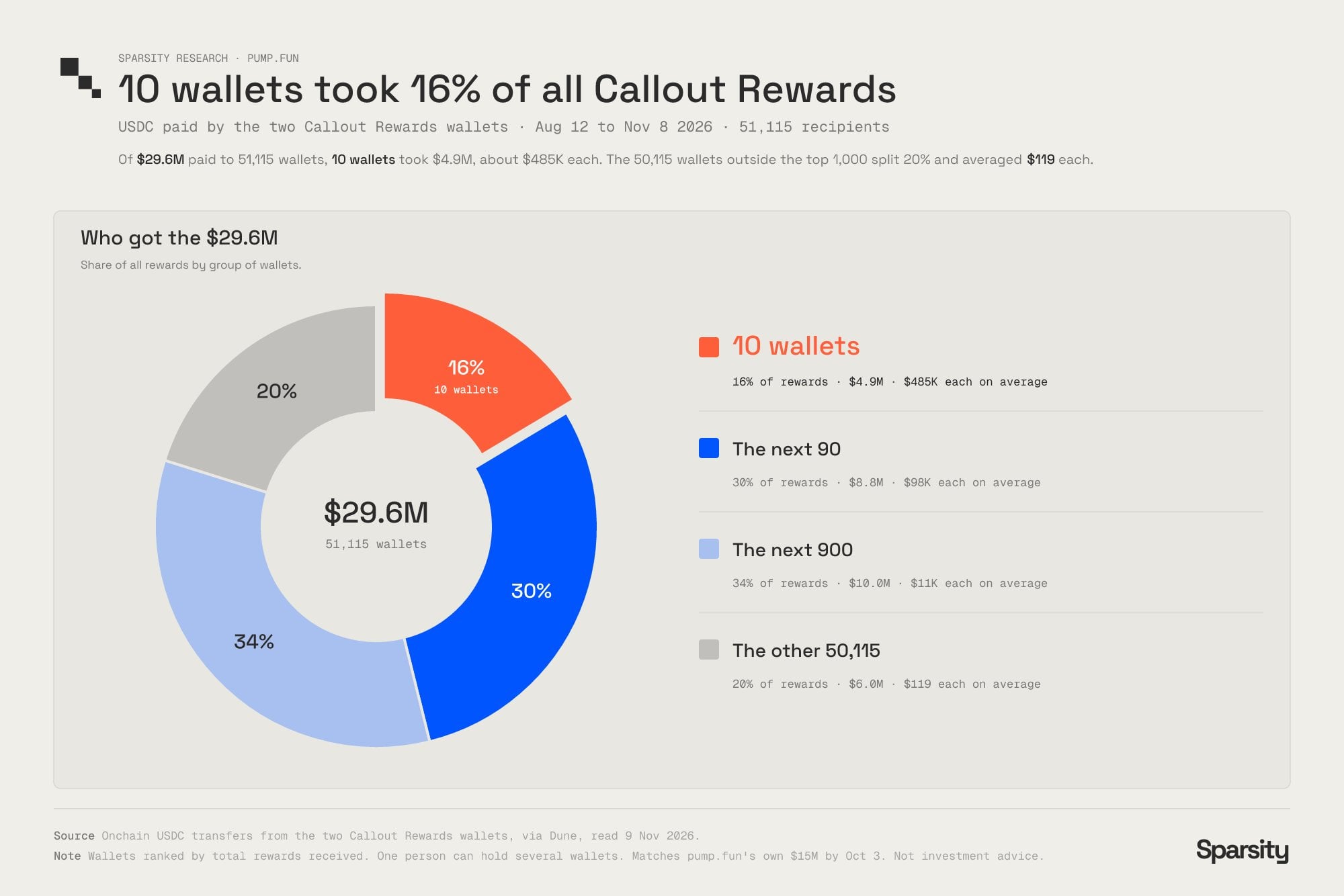
Paid calls. Since August, in the period the distribution chart labels August 12, 2026 through November 8, 2026, the platform had paid $29.6 million in call rewards to 51,115 wallets. Distribution was highly uneven: 10 wallets took 16% of the total, and the median recipient received $13. The top 10 wallets were described as averaging about $485,000 each.
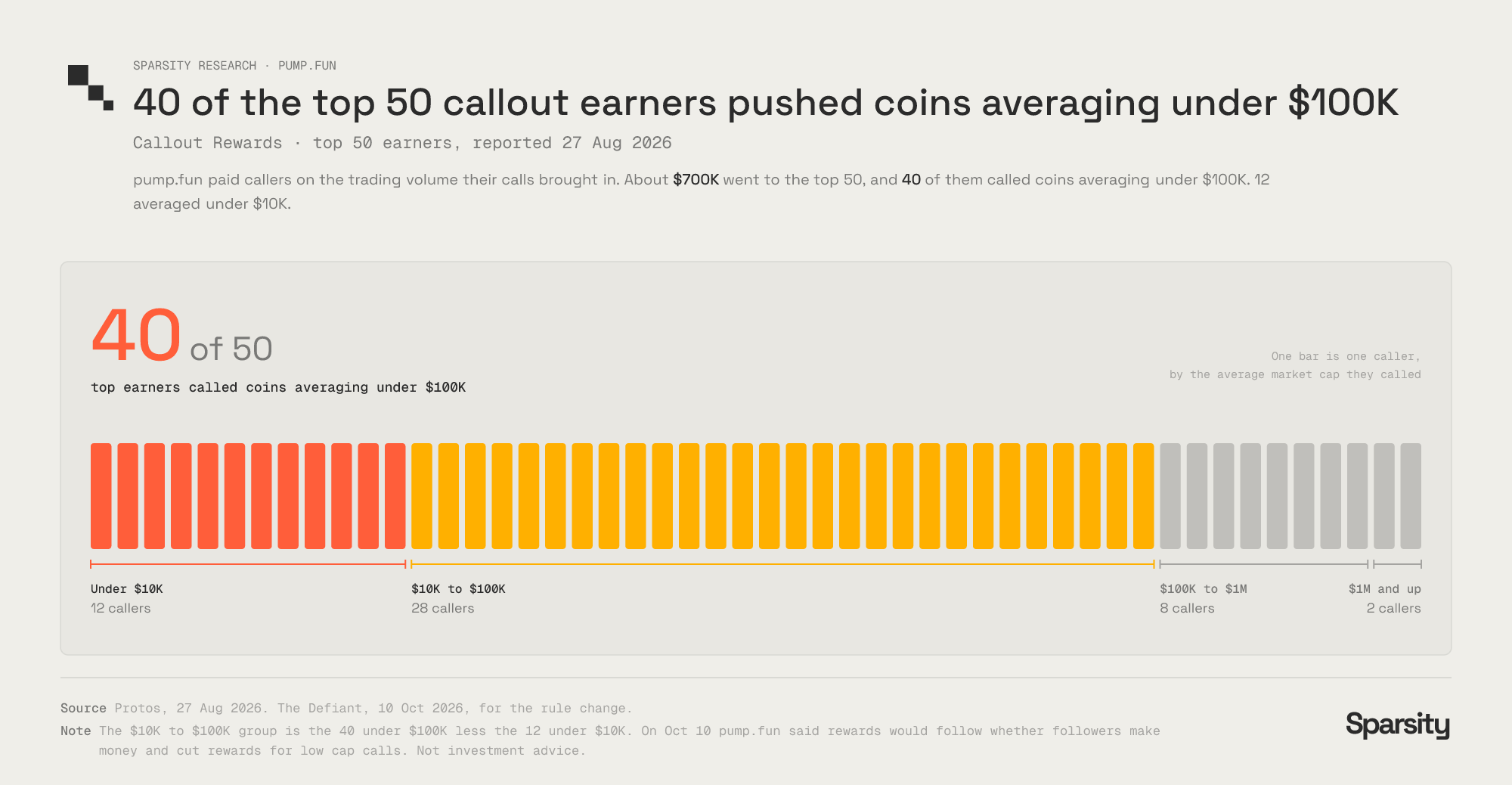
Rewards were calculated from trading volume attributed to calls. Thin small-cap books were the easiest to move. In August, among the 50 highest-earning callers, 40 mainly promoted tokens with an average market cap under $100,000, and 12 of those had an average under $10,000.
Player-versus-player mode. The stated aim was faster fills and more trades per user when new capital was scarce, with experienced traders taking from newer ones. Each fill generated a fee. On June 30 — the source gives the day and month but not the year — Pump.fun discontinued one such mode, Tokenized Agent. The reason it gave, as reported here, was that too many launch channels had produced a “malignant” player-versus-player ecosystem. That discontinuation is reported as completed, not as a future item.
The October 10 weighting change, and the next three weeks
The analysis says Pump.fun had already heard the criticism. On October 10 — dated in the 2026 sequence of this review, which runs through early November 2026 — the platform said later incentives would be linked to followers’ profit and loss and that the reward weight on small-cap calls would be reduced. That is reported as an announcement, not as proof the payout mix then changed as announced.
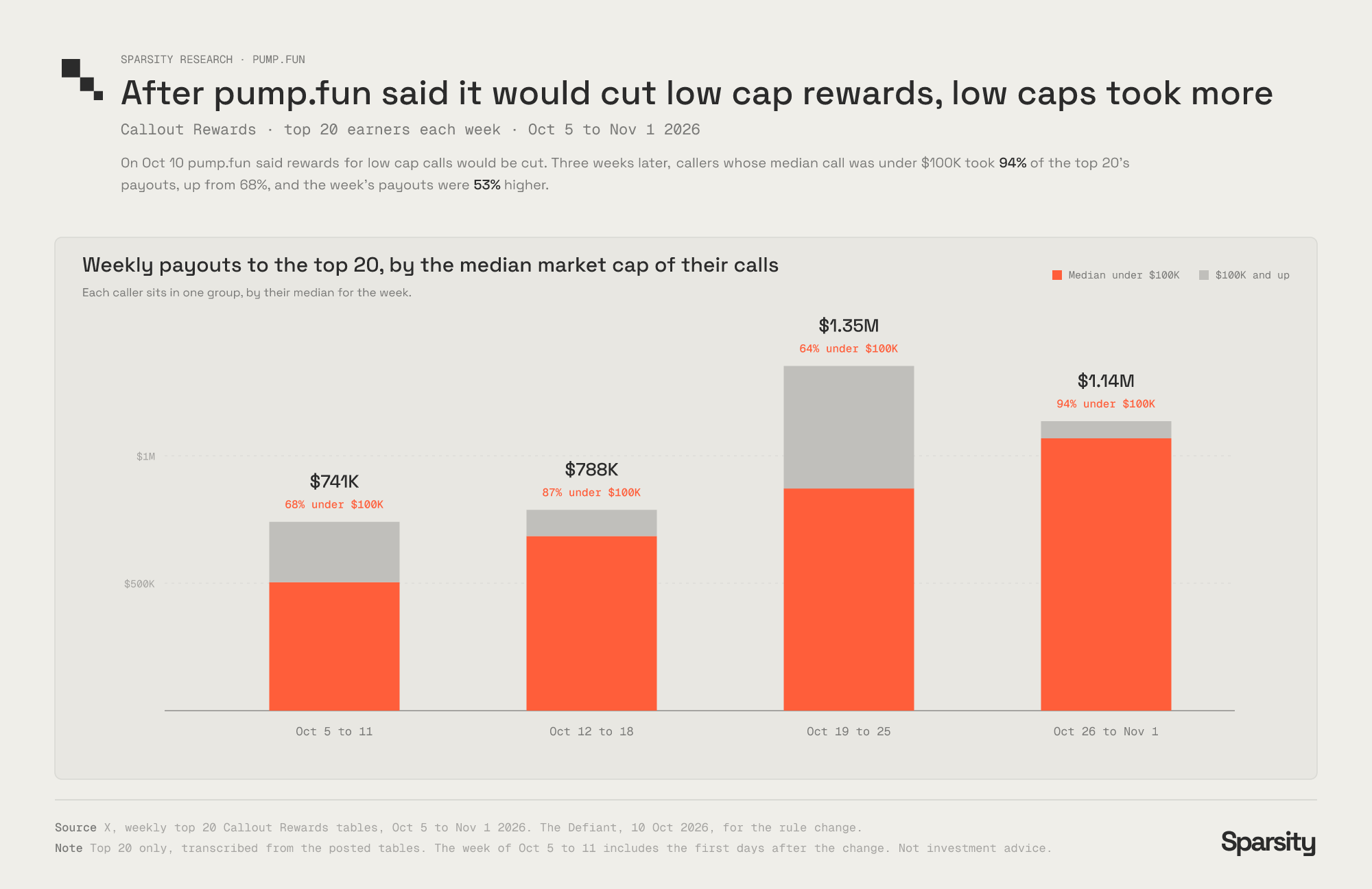
In the three weeks after that rule statement, the analysis says the opposite showed up in the top of the leaderboard. Of bonuses to the top 20 callers, the share aimed at tokens whose median market cap was under $100,000 rose from 68% to 94%, and the weekly bonus total rose 53%.
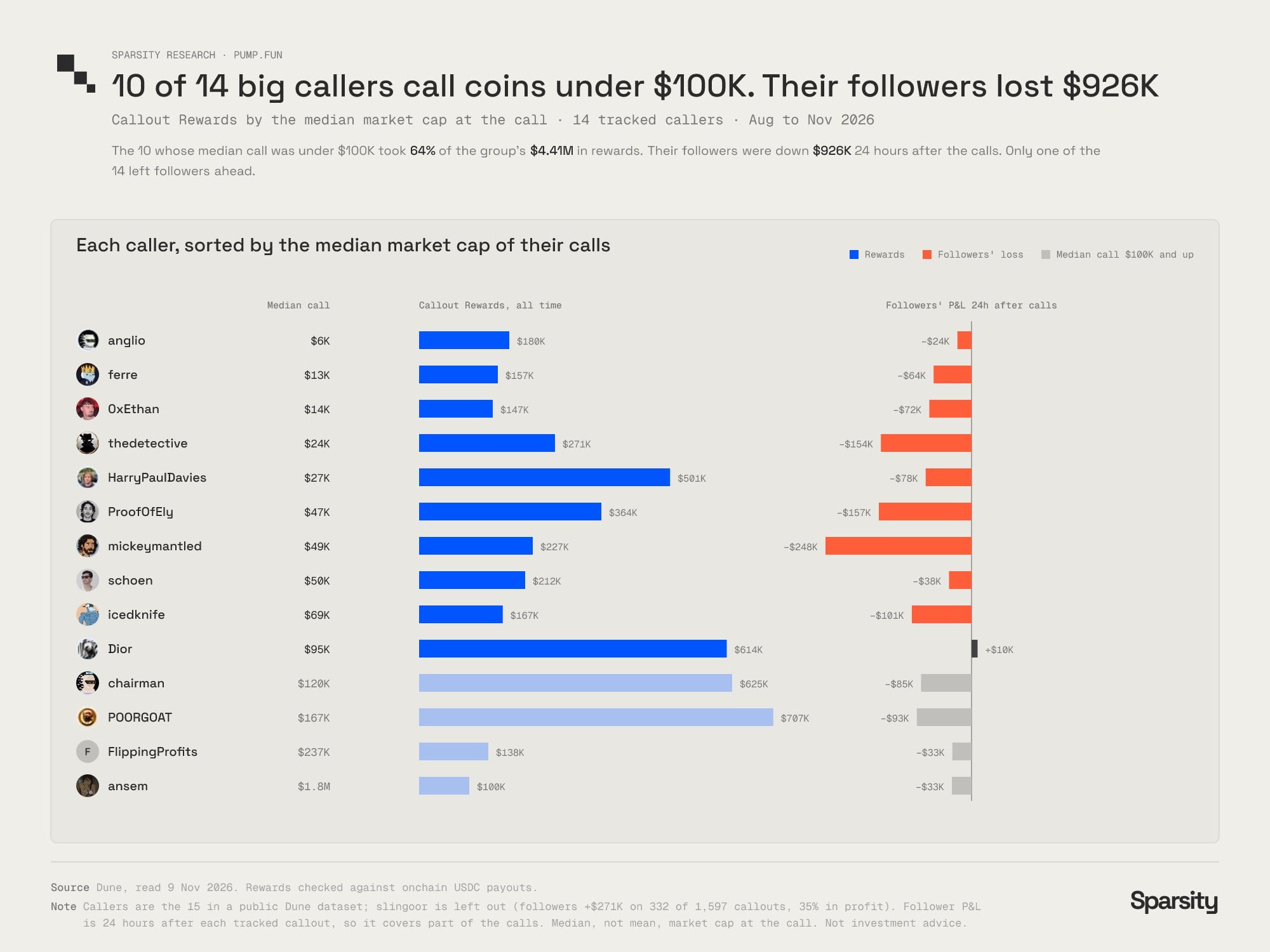
Losses were assigned to people who followed the calls. A research tracking set of 14 callers included 10 whose promoted tokens had a median market cap under $100,000; their followers were said to have lost $926,000 combined on the day after the calls. Of the 14, only one was said to have left followers with a small profit, $10,000. A later passage in the same piece restates the $926,000 one-day loss for followers of the callers who did not produce a profit.
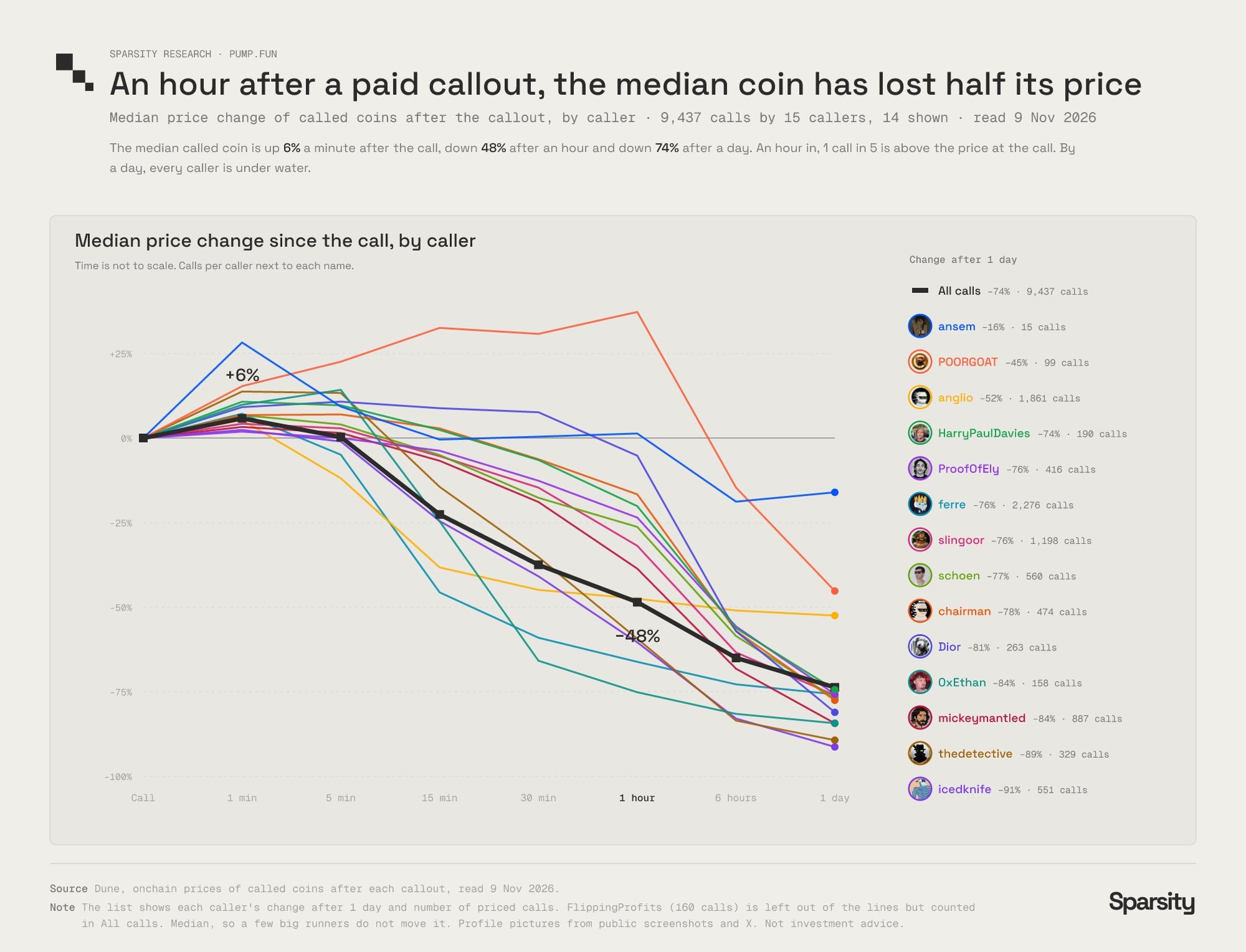
For the called tokens, the reported median path was up 6% one minute after the post, down 48% after one hour, and down 74% after one day. Median prices were lower the day after the call for all of those tokens. Callers were paid whether the token rose or fell. The essay’s interpretation is that the incentive itself paid for recommending tokens that followers then lost on.
Launch counts versus tokens that cleared $10 million
The analysis splits the market into a demand side that, on its long-run count, mostly lost money in meme speculation, with only a few wallets making large gains, and a supply side that could issue almost without risk. Launching was one click. Methods it lists as already mature, and revised month to month, include riding a hot token’s attention, fabricating volume, and buying batches of old wallets to issue from.
Its account of the “holding consensus” breaking is that issuing paid and holding tended to lose, so people who had preferred to hold became issuers and split a shrinking pool of buy-side funds. That is the author’s explanation, not a measured survey of intent.
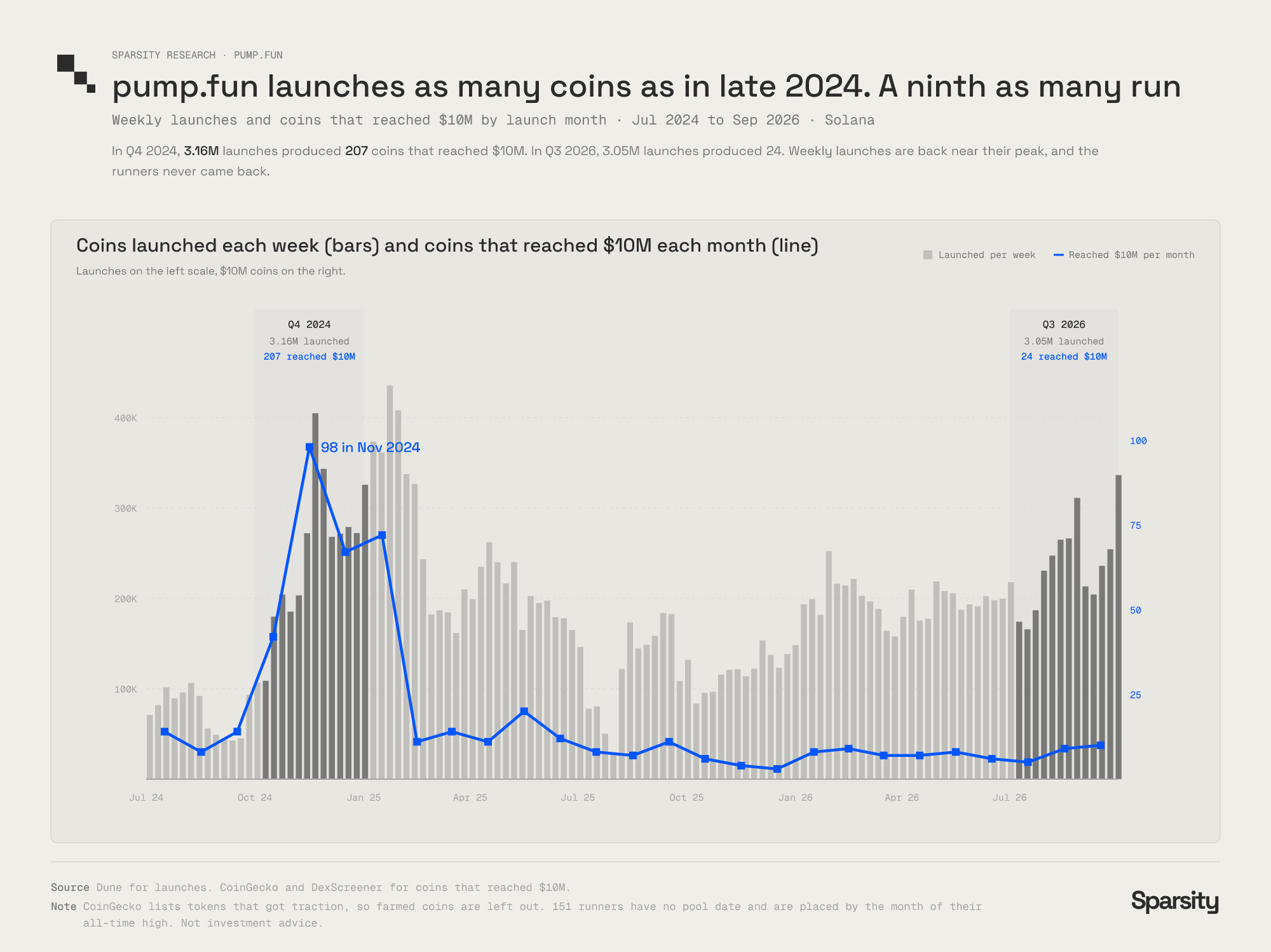
On quality, Pump.fun’s launch total at the time of the piece was described as roughly level with the late-2024 peak:
- 2024 fourth quarter: 3.16 million launches, and 207 tokens that broke a $10 million market cap.
- 2026 third quarter: 3.05 million launches, and 24 such tokens.
Weekly new launches were back above 300,000. The analysis’s rate of a breakout per 100,000 launches fell from 6.5 to 0.8.
It accepts as true that bonding-curve volume had risen since June. Combined bonding-curve and PumpSwap volume, however, was said to have fallen from $25–30 billion a month in the first quarter of 2026 to $13.8 billion in the October cited in that comparison. The platform’s income is the fee on volume. Buyers’ outcome, in the essay’s framing, depended on breakouts, and breakout production was about one-ninth of the earlier pace.
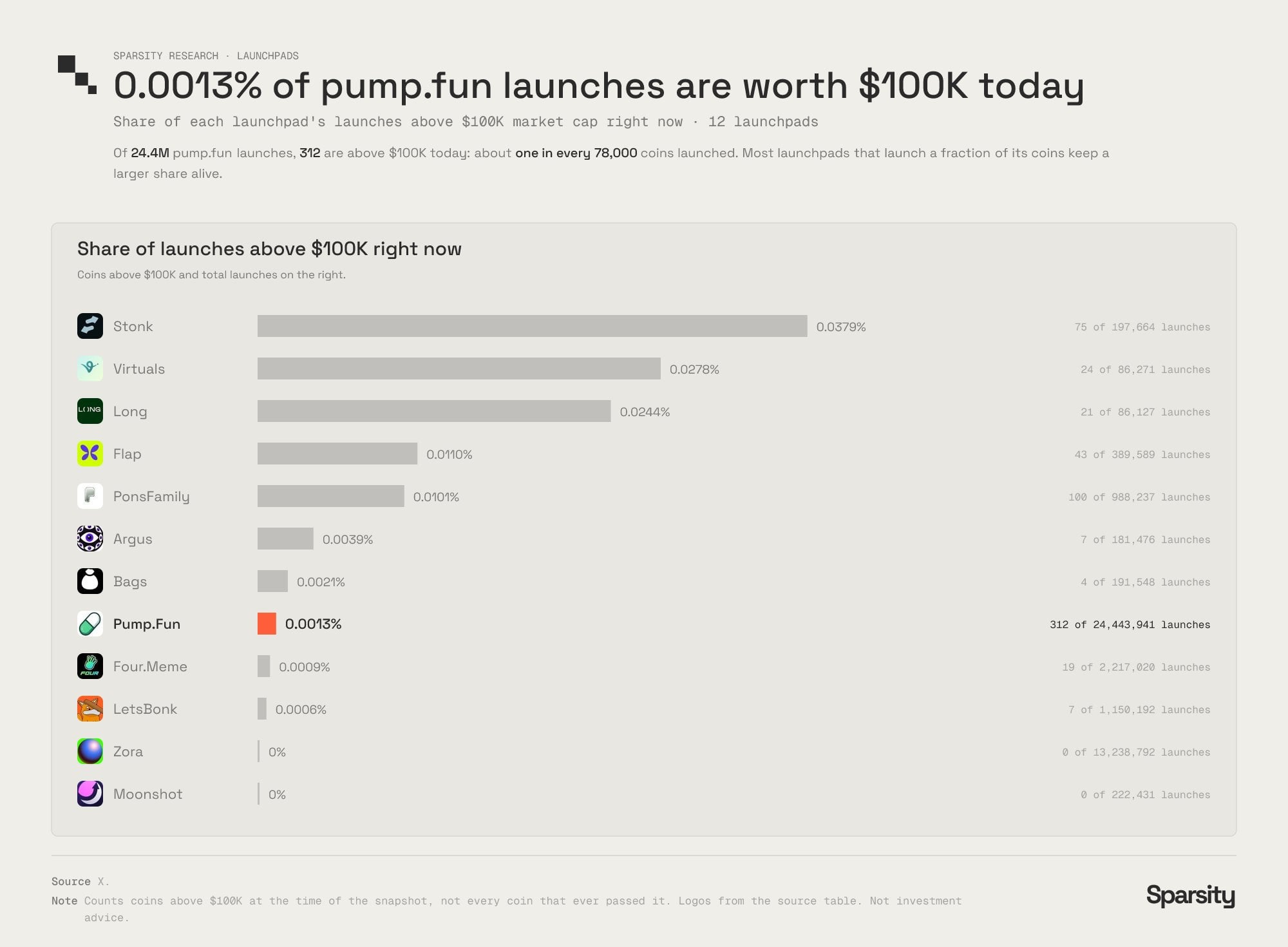
Of 24.4 million cumulative Pump.fun launches, only 312 tokens still had a market cap above $100,000 on the statistics date used in the piece — about 1 in 78,000, a 0.0013% survival rate. That rate was described as lower than on most similar platforms with much smaller issuance. The authors call this the first market they had observed in which supply expanded quickly while demand decayed at the same time, and they say it would not have reached that scale without the incentive system. Both sentences are their conclusion.
Who supplied the other side of the trade
The system is attributed to Pump.fun, but the volume that kept it running is attributed to traders. The arbitrage described pays only if someone takes the other side. The essay says critics often still followed the next bundled launch, praised harvests of hot tokens, or followed callers who posted about 20 tokens a day because the posts were early, not because followers made money. It repeats that only one of the 14 tracked callers left followers in profit.
The double cost it names is the reader’s own volume, from which Pump.fun and creators took fees, and the reader’s attention, which later hype cycles and calls competed for.
On holding period: a year before the article, the mainstream approach it describes was to find a candidate early and hold through volatility. At the time of writing, the median called token was down 74% after one day, and the traders who remained were those who sold first. Selling first is called individually rational and, if everyone does it, fatal to a long move. If nobody held past the first hour, a token could not grow to a tens-of-millions market cap — and that first hour was three-quarters of Pump.fun’s revenue in the figures above. This is an argument about incentives, not a forecast of any token’s price.
Changes the essay suggested, with no claim they were scheduled
Nothing in the source is a confirmed Pump.fun upgrade date. The authors say readers need not wait for the platform’s permission, and they list behavior changes: hold a token one actually favors instead of turning over on every move; judge callers by whether followers make money, not by how often they post; stop circulating front-running and bundled launches as clever strategy; and send volume to launch venues that pay for a token lasting rather than for rapid turnover. They say no single step rewrites the underlying incentive, but that volume which does not enter the system reduces fee income.
They also say they are not contract engineers. The redesign notes are ideas, not an implementable specification and not a published roadmap:
- Move the revenue point later than the first hour after launch.
- Raise the initial market cap and start with deeper liquidity, with liquidity compounding as volume grows.
- Share fees with holders and liquidity providers, not only creators, and unlock creator fees on a schedule tied to how long the token survives.
- Pay callers for followers who still hold and are in profit days later, not for the volume the call generates.
They argue Pump.fun could afford to test this because it held about $2.84 billion in on-chain assets and controlled the issuance path. Their view is that a market which kept producing longer-lived meme coins would, over time, earn the platform more than a model that keeps spending buyers’ funds — and that the short extraction was chosen because it was more profitable at the time, not because it could continue. They add that even these changes might not be enough: they would raise costs for launchers and bundlers, but would not remove the tool advantage on the supply side.
A fixed-price raise, also only a proposal
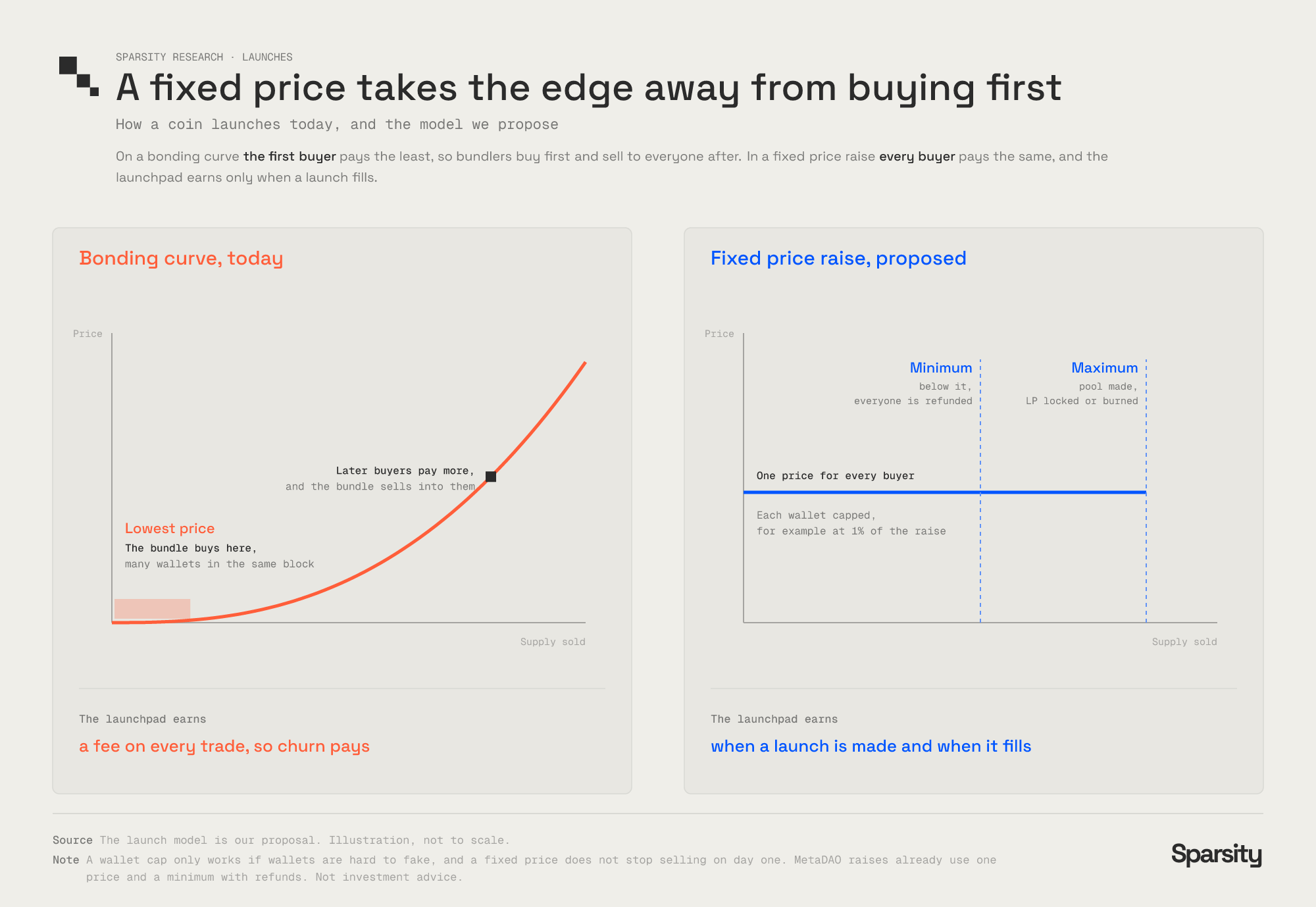
A further idea in the same essay drops the bonding curve entirely. It is not described as live:
- Every participant subscribes at the same price, so being early in a block is not a premium and sniping has no curve advantage.
- The issuer sets a raise floor and cap. If the floor is missed in a fixed window of 24 or 48 hours, the contract refunds in full and a failed issue does not lose buyers’ money. At the cap, a pool is created automatically, LP tokens are burned or locked permanently, and the developer cannot use the raised funds.
- Each wallet is capped, for example at 1% of the raise, against whales or bots taking most of the supply.
- The platform is paid only when a raise succeeds. Failed raises, even in the thousands, pay the platform nothing. The charge point moves from each trade to each successful raise.
The analysis says this would remove bonding-curve bundle sniping, block sniping, and a developer removing liquidity, and would remove the payoff for launching dozens of tokens in hope that one hits. It also lists limits: a per-wallet cap is weak against Sybil attacks because old wallets were cheap to buy in bulk, so bundlers could still split funds; a single subscription price does not stop a dump on the first day. It only equalizes the start.
What the authors said had already ended
As of this November 11, 2026 publication, the authors’ judgment was that the meme-coin narrative in its then-current form had run out. They wrote that unless the issuance model changed in the direction above — platform income from a successful raise rather than from trading and from tokens going to zero — meme coins were unlikely to recover the earlier ecosystem. As long as a launch platform could earn from tokens going to zero and from rapid turnover, long-term holding would remain the worse strategy under those rules. They expected something else to appear later, not soon, and not in the form meme coins then had.
No date in this piece is a decision deadline, a halving, or a guaranteed listing action. The October 10 statement and the June 30 Tokenized Agent shutdown are the only platform actions the review dates; the shutdown’s year is not given. None of the figures is a claim that an event will move a price.
Original article: PANews, November 11, 2026, 18:43 CST.